
A line-by-line walkthrough of Schedule C for freelancers in 2025, with a worked example for a freelancer who earned $72,000, the lines you can ignore, and the four 2025 changes most people miss.

It’s 11pm on a Sunday in mid-March. You have a stack of 1099-NECs, a Stripe payout history, an Adobe subscription you forgot you were paying for, and a folder labelled “tax stuff 2025” with about half of what you need. You opened Schedule C an hour ago. You closed it forty minutes later. You just opened it again.
The form is two pages. It has 48 numbered lines. The IRS instructions run more than 20 pages of dense language. Almost no freelancer reads them. You don’t need to either.
This walkthrough takes the 2025 Schedule C, which is the form you file for tax year 2025 by April 15, 2026. You’ll see what goes on each line, which lines you can skip if you sell services with no inventory and no employees, and what the four 2025 changes mean for you. There’s a worked example running through the whole article. Her name is Maya. She’s a freelance illustrator who earned $72,000 in 2025. We’ll fill her form out with you.
Start with the structure of Schedule C for freelancers
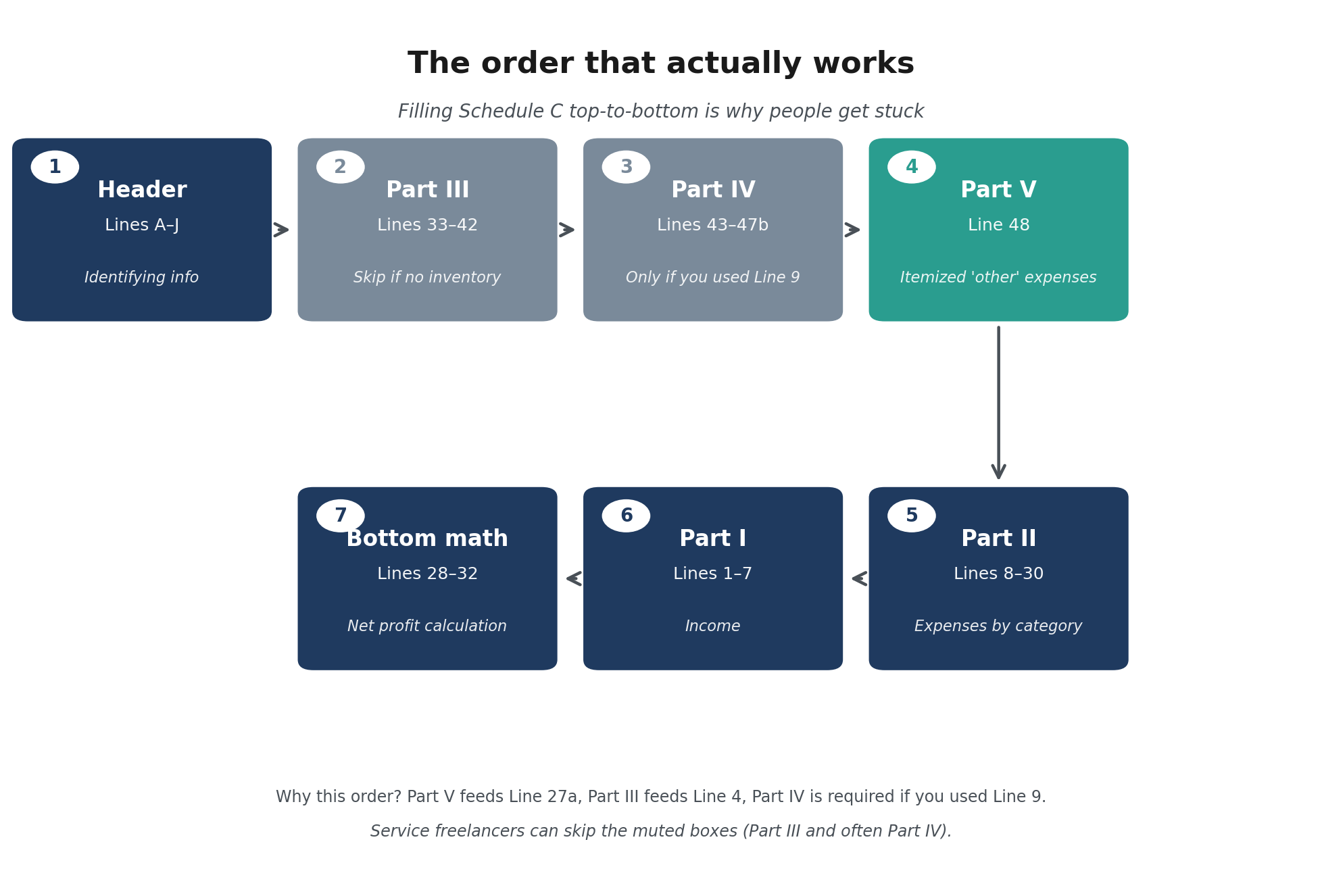
Schedule C has five parts. Most people try to fill them in top to bottom. That’s why they get stuck. The order that actually works is this:
- The header (Lines A through J). Your business identifying info.
- Part III (Lines 33 through 42). Only if you sell physical products. Skip it if you sell services.
- Part IV (Lines 43 through 47b). Only if you claimed vehicle expenses on Line 9.
- Part V (Line 48). Itemized “other expenses” that don’t fit Lines 8 to 27a.
- Part II (Lines 8 through 30). Your expenses by category.
- Part I (Lines 1 through 7). Your income.
- Lines 28 to 32. The math at the bottom that gives you your net profit.
Why this order matters: Part V feeds Part II Line 27b. Part III feeds Part I Line 4. Part IV is required if you claimed Line 9. Start at the top and you’re guessing about totals that come from sections you haven’t filled in yet.
If you sell services and don’t claim vehicle expenses, the form shrinks to: header, Part V (for software subscriptions and bank fees), Part II, Part I, and the bottom math. That’s most freelancers reading this.
Meet Maya
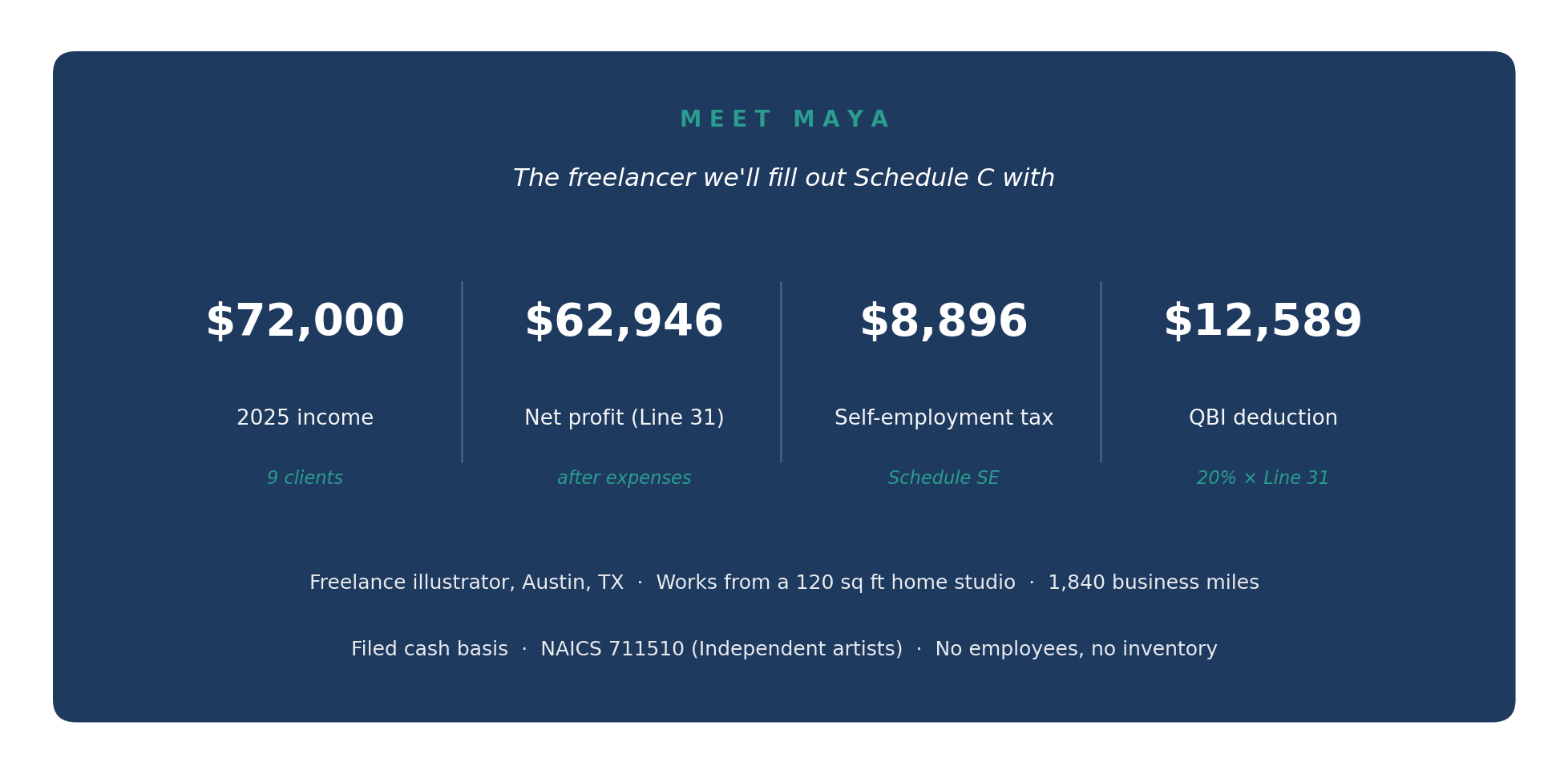
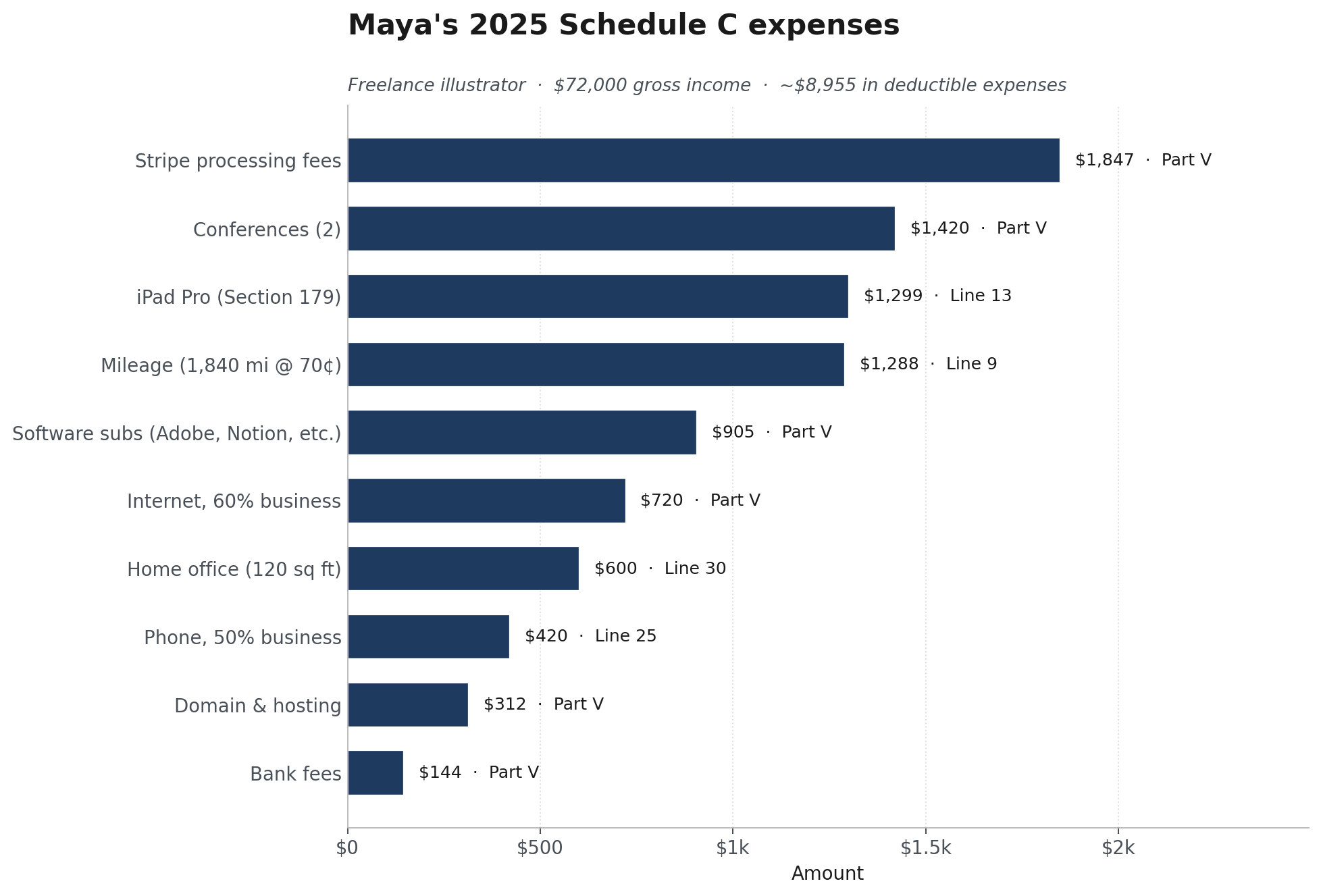
Maya is a freelance illustrator. In 2025 she earned $72,000 across nine clients. Six of them sent her 1099-NECs adding up to $61,400. The other three paid through Stripe and didn’t issue 1099s. She works from her apartment in Austin. She drove 1,840 business miles to meet two local clients. Her business expenses for the year:
- Adobe Creative Cloud: $719.88
- Procreate and other apps: $89
- Notion: $96
- Domain and website hosting: $312
- Stripe processing fees: $1,847
- Business bank account fees: $144
- iPad Pro for work, Section 179 expensed: $1,299
- Internet at home, 60% business use: $720 of $1,200
- Phone, 50% business use: $420 of $840
- Two industry conferences: $1,420
- Health insurance, which goes on Schedule 1, not here: $4,800
- Mileage: 1,840 business miles at 70 cents = $1,288
- Home office, simplified method: 120 sq ft x $5 = $600
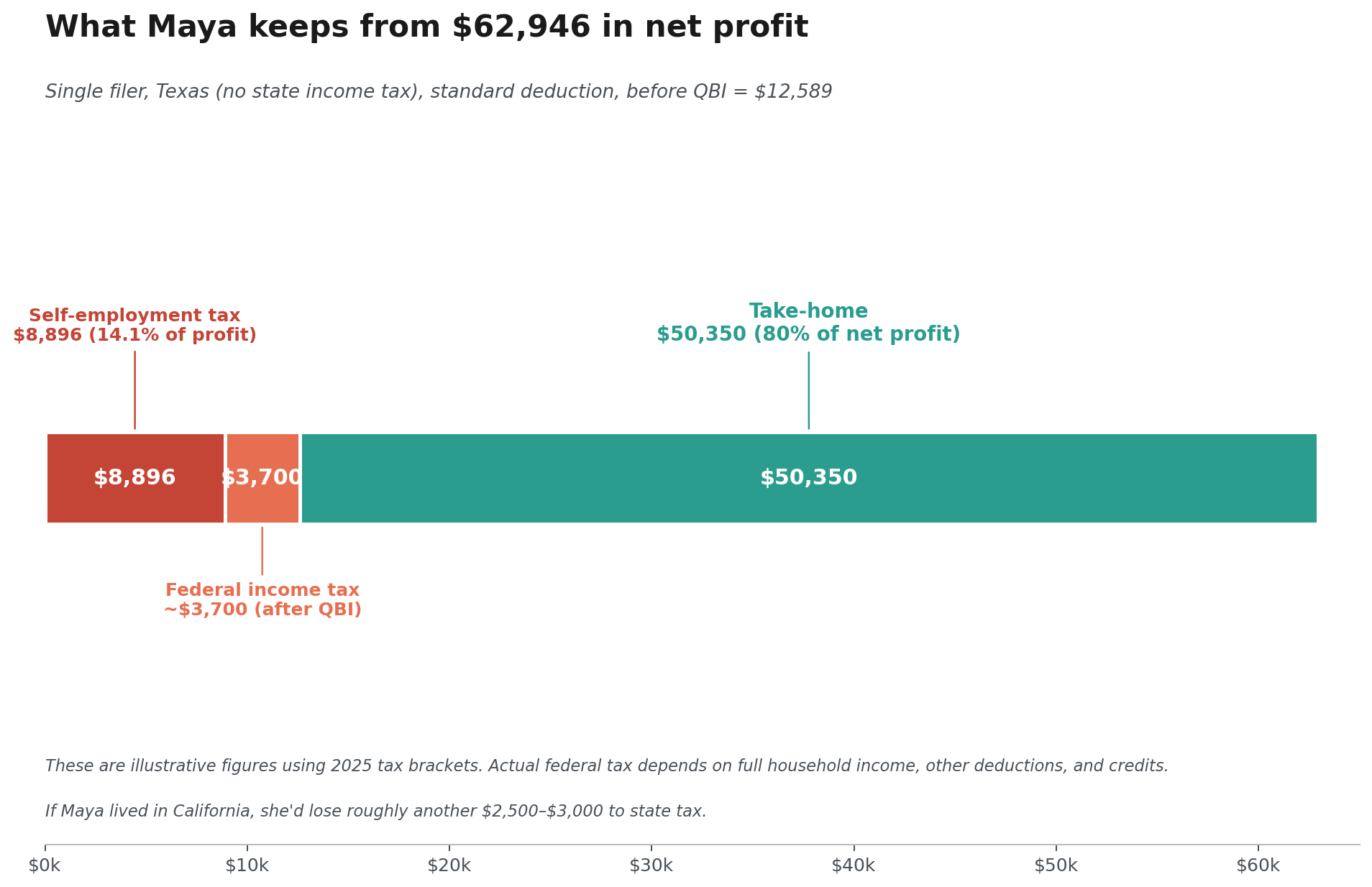
Total business expenses on her Schedule C: roughly $9,054. Net profit: about $62,946. Self-employment tax on that profit: $8,896. We’ll trace those numbers as we go.
The header: Lines A through J
The top of the form looks short and easy. Lines B and F are where people slip up.
Name of proprietor and SSN
Your legal name and your Social Security Number. Not your business name. Not your DBA. If you file jointly, only the spouse who runs the business goes here.
Line A: Principal business or profession
Plain English. “Freelance illustrator.” “Software developer.” “Marketing consultant.” There’s no perfect answer. Pick what describes most of your work.
Line B: Principal business code (NAICS)
A six digit code that tells the IRS what industry you’re in. They use it to compare your expense ratios against other businesses in the same category. Pick the wrong code and your deductions can look like outliers, which the IRS uses as one of many audit selection signals.
Common codes for freelancers:
- 541430. Graphic design services.
- 541511. Custom computer programming services for developers.
- 711510. Independent artists, writers, performers.
- 541613. Marketing consulting.
- 541810. Advertising agencies, and freelance copywriters who work mainly in advertising.
- 541990. All other professional services. Use this only if nothing else fits.
The full list lives in the back of the IRS Schedule C instructions on irs.gov. Maya picks 711510 (independent artists).
Line C: Business name
If you have a DBA or LLC name, put it here. If you operate under your own name, leave it blank. Don’t invent something to fill the box.
Line D: Employer Identification Number (EIN)
Only fill this in if you applied for an EIN with the IRS. Your SSN at the top is enough if you didn’t. Single-member LLCs without employees aren’t required to have an EIN, though many freelancers get one for free at irs.gov so their SSN doesn’t have to go on every W-9.
Line E: Business address
If your business address is the same as your home address on your 1040, leave Line E blank. If you have a separate office, list that address.
Line F: Accounting method
Cash or accrual. Almost every freelancer should pick cash. Cash means you record income when the money hits your account and expenses when you pay them. Accrual means you record income when you invoice and expenses when you get a bill, no matter when money actually moves. Cash is simpler. It also matches how you actually live.
Line G: Did you materially participate?
If you did the work yourself, check yes. This question separates active income (which is subject to self-employment tax) from passive investment income. Freelancers doing their own work always check yes.
Line H: Did you start or acquire this business in 2025?
Check it if 2025 was your first year. Otherwise leave it.
Lines I and J: Did you make payments that required you to file 1099s?
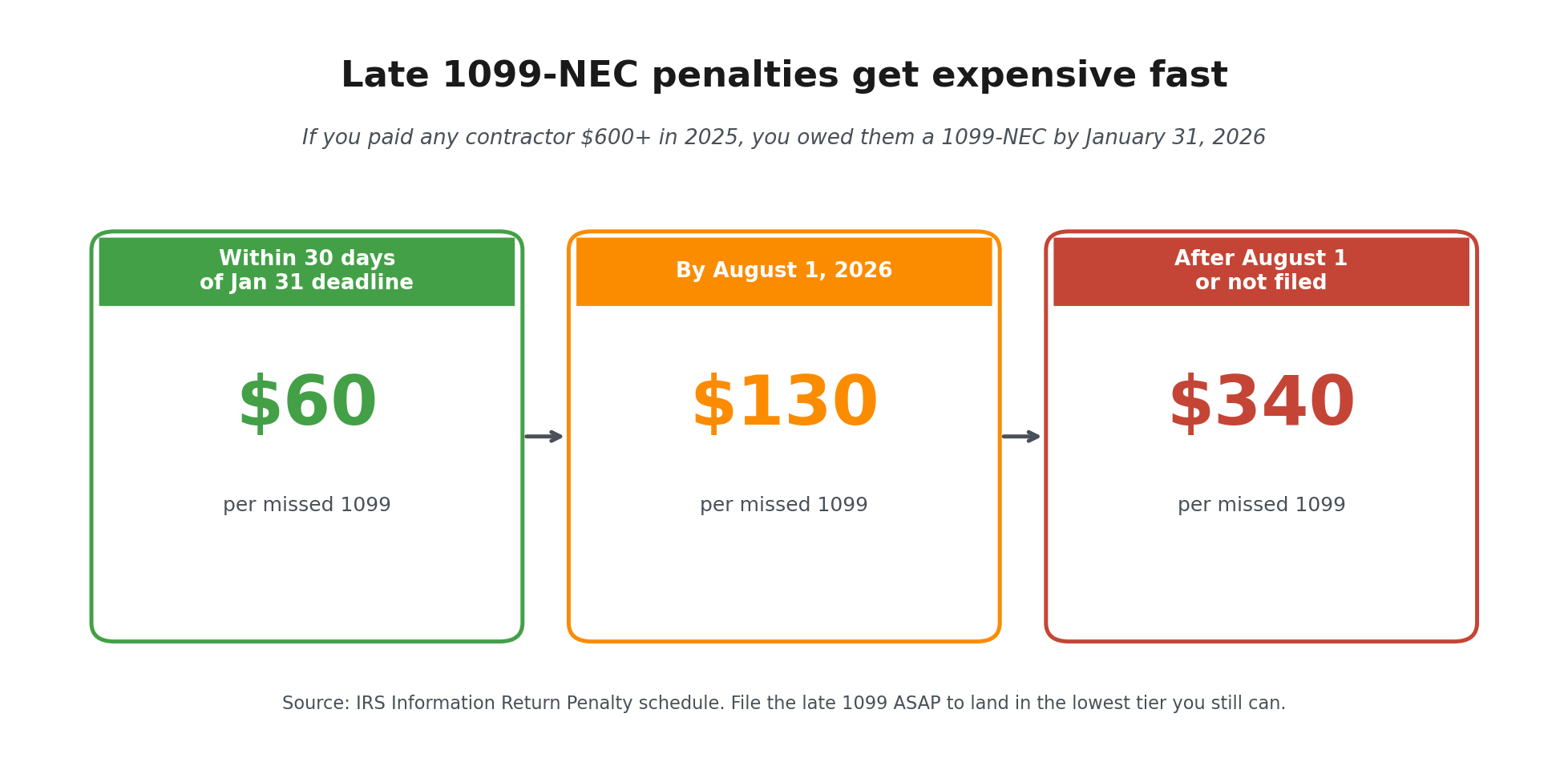
This is where first-time filers slip. Pay any contractor $600 or more for services in 2025 (a virtual assistant, a freelance editor you sub-contracted, a designer you hired) and you were required to issue them a 1099-NEC by January 31, 2026. Line I asks if you had to. Line J asks if you actually did.
Most solo freelancers haven’t paid any contractor $600 or more for services. Both answers are no. If you did pay someone and didn’t file the 1099-NEC, you’re already late. The penalty is $60 to $340 per missed 1099 per the IRS Information Return Penalty schedule, depending on how far past the January 31 deadline you file. Filed within 30 days of the deadline is $60. Filed by August 1 is $130. After August 1 the penalty hits $340. File the late 1099 as soon as possible to land in the lowest tier you still can.
Part I: Income (Lines 1 through 7)

Line 1: Gross receipts or sales
Every dollar you earned from your business in 2025. All of it. Including income that didn’t show up on a 1099-NEC or 1099-K. The $600 threshold decides whether your client is required to send you a 1099. It does not decide whether you have to report the income. You report all of it.
For Maya: $72,000. That includes the $61,400 from her six 1099-NECs and the $10,600 paid through Stripe with no 1099 issued. The IRS already has copies of those six 1099s from her clients. If her Line 1 came in below $61,400, she’d get an automated CP2000 notice within 12 to 18 months.
Line 2: Returns and allowances
Refunds you issued to clients during the year. Most service freelancers leave this at zero. Refund a client $500 in May and that’s a positive number here.
Line 3
Line 1 minus Line 2. Just math.
Line 4: Cost of goods sold
Pulled from Line 42 of Part III. Service freelancers leave it at zero. You only have COGS if you sell physical products like handmade goods, resold inventory, or anything you manufacture. Maya leaves it blank.
Line 5: Gross profit
Line 3 minus Line 4. For service freelancers, this matches Line 3.
Line 6: Other income
Business income that didn’t come from your main service. Examples: late fee income from clients, scrap sales, federal or state fuel tax credits, recovered bad debts. Interest from your business bank account does not go here. That goes on Form 1040 Line 2b.
Maya leaves Line 6 blank.
Line 7: Gross income
Line 5 plus Line 6. For Maya: $72,000.
Part II: Expenses (Lines 8 through 30)
Most of the work happens here. So do most of the mistakes. The trick is matching every expense in your bookkeeping (or your shoebox) to the right line. Putting the right thing on the wrong line doesn’t change your total deduction. It can flag your return for review if a line looks unusual for your NAICS code.
Here’s the full list, with what most service freelancers actually use marked clearly. For more on which expenses qualify in the first place, see our guide to tracking business expenses and our freelancer tax deductions roundup.
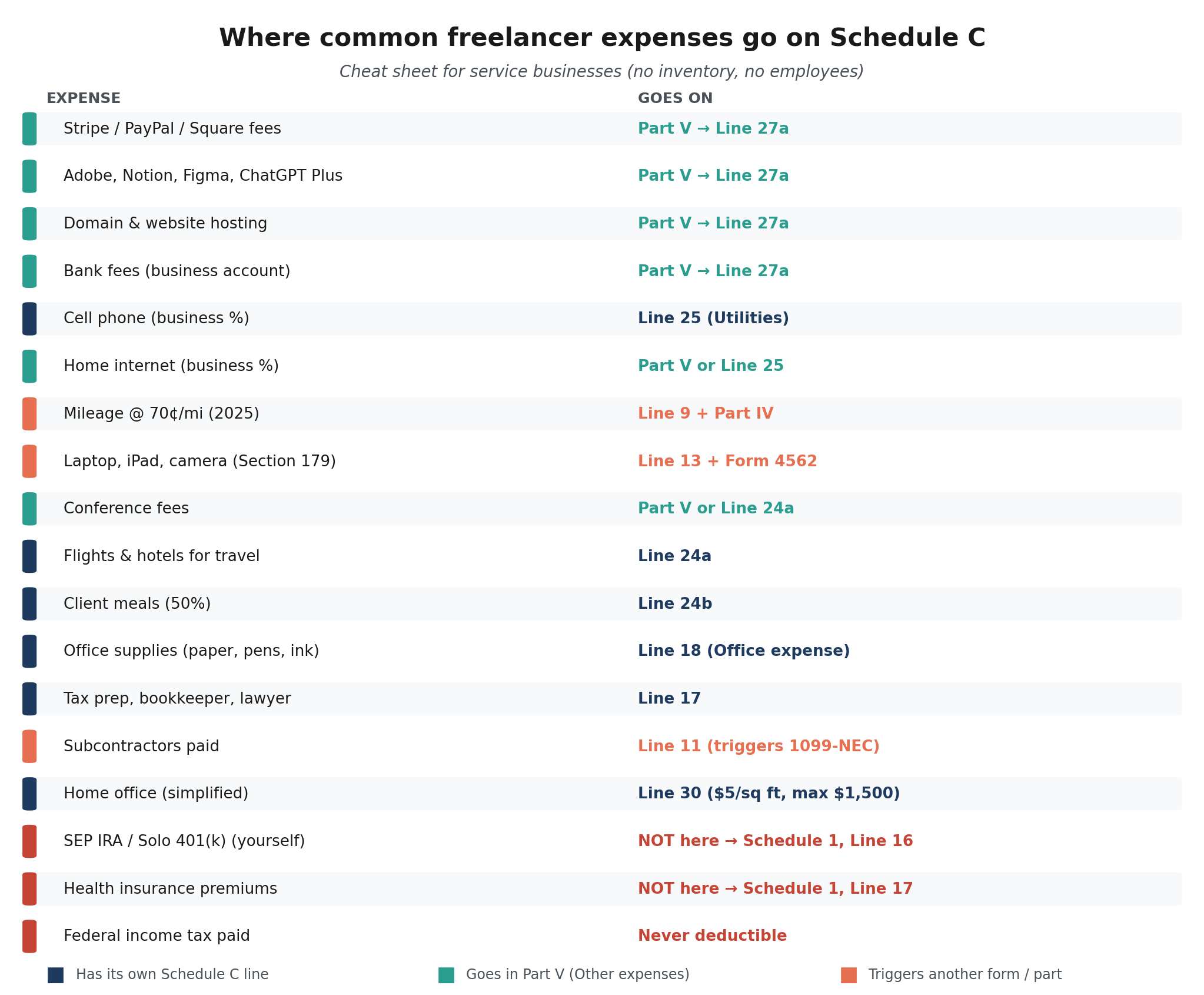
The Schedule C Part II line map for service freelancers
| Line | What it covers | Use it? | Common freelancer examples |
|---|---|---|---|
| 8 | Advertising | Often | Google Ads, Meta Ads, business cards, sponsored posts, podcast ads |
| 9 | Car and truck expenses | Sometimes | Mileage at 70¢/mile (2025) OR actual costs. Triggers Part IV. |
| 10 | Commissions and fees | Rarely | Sales commissions you paid to a referrer. Not the same as contract labor. |
| 11 | Contract labor | Sometimes | Subcontractors you paid for client work. Triggers Lines I and J above. |
| 12 | Depletion | No | Mining and timber only. Skip it. |
| 13 | Depreciation and Section 179 | Sometimes | Laptop, camera, equipment over $200. Section 179 lets you expense the full cost in year one. |
| 14 | Employee benefit programs | No | Only if you have employees. You’re not your own employee. |
| 15 | Insurance (other than health) | Sometimes | Professional liability (E&O), cyber insurance, business equipment insurance. |
| 16a/16b | Interest (mortgage / other) | Rarely | Interest on a business loan or business credit card. Personal credit card interest doesn’t count. |
| 17 | Legal and professional services | Often | Tax prep fees, bookkeeper, lawyer for contract review. |
| 18 | Office expense | Often | Paper, pens, postage, printer ink. NOT software subscriptions. NOT home office. |
| 19 | Pension and profit-sharing plans | No | Only contributions for employees. Your SEP IRA or Solo 401(k) goes on Schedule 1, Line 16, not here. |
| 20a | Rent or lease (vehicles, equipment) | Sometimes | Leased camera, leased coworking equipment. |
| 20b | Rent (other business property) | Sometimes | Coworking space, studio rent. Not your home; that’s Line 30. |
| 21 | Repairs and maintenance | Rarely | Fixing equipment. Not capital improvements. |
| 22 | Supplies | Often | Materials consumed in your work. For an illustrator: ink, paper, brushes. |
| 23 | Taxes and licenses | Sometimes | Business license, state franchise tax, professional license renewals. NOT federal income tax. |
| 24a | Travel | Often | Flights, hotels, conference travel. 100% deductible. |
| 24b | Meals (50%) | Sometimes | Business meals with clients or while traveling. 50% deductible. |
| 25 | Utilities | Sometimes | Business phone line, business internet (only the business portion). Most freelancers split this between here and Part V. |
| 26 | Wages | No | Only if you have W-2 employees. Subcontractors go on Line 11. |
| 27a | Other expenses (from Part V) | Yes | The catch-all. Software subscriptions, bank fees, payment processor fees go in Part V, then totaled here. |
| 27b | Energy efficient commercial buildings deduction | No | New for 2025. Most freelancers skip. |
| 28 | Total expenses (before home office) | Auto | Sum of Lines 8 through 27b. |
| 29 | Tentative profit | Auto | Line 7 minus Line 28. |
| 30 | Home office | Often | Simplified method: $5/sq ft up to 300 sq ft = $1,500 max. Or attach Form 8829 for actual expenses. |
Where do my Stripe and PayPal fees go?
This is the most asked question on r/tax and r/freelance about Schedule C. Stripe, PayPal, and Square processing fees don’t have a dedicated line. They go in Part V (Other expenses), itemized as “Payment processing fees,” then carried to Line 27a.
Maya’s $1,847 in Stripe fees go in Part V, Line 48, with the description “Payment processing fees.”
Where do my software subscriptions go?
Adobe, Notion, Figma, Canva Pro, ChatGPT Plus, GitHub, Slack. None of these have a dedicated line. They go in Part V as “Software subscriptions,” or itemized one by one, then carried to Line 27a. They do not go on Line 18 (Office expense). Line 18 is for physical office supplies.
Maya’s software adds up: Adobe ($720) + Procreate and apps ($89) + Notion ($96) + domain and hosting ($312) = $1,217. All in Part V.
Where does my phone bill go?
If your phone is mixed personal and business use (most freelancers), only the business portion is deductible. Work out a fair percentage based on actual use. Don’t claim 100% if you also use the phone to text your mom and scroll Instagram. Then put it on Line 25 (Utilities) or Part V (Other expenses, “Cell phone, business portion”). Either is defensible. The IRS expects you to be able to justify the percentage if asked.
Maya’s phone is 50% business: $420 of her $840 annual cost. She puts it on Line 25.
Line 9 deep look: car and truck expenses
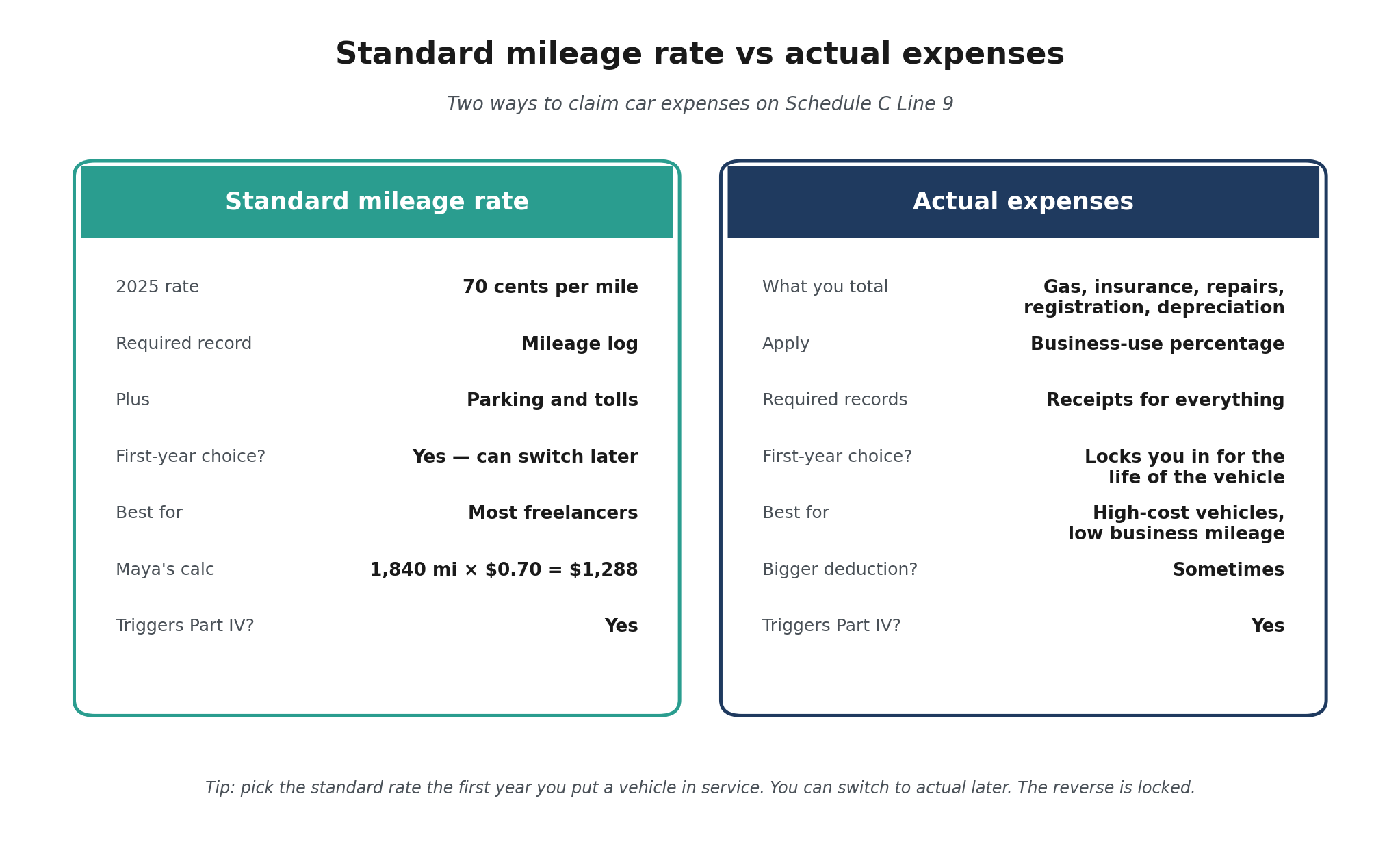
Two methods to claim car expenses. You usually have to commit to one for the life of the vehicle if you started with the standard mileage rate:
- Standard mileage rate. 70 cents per business mile for 2025, up from 67 cents in 2024. Multiply business miles by 0.70. Add parking and tolls separately.
- Actual expenses. Total your gas, insurance, repairs, registration, and depreciation, then multiply by your business-use percentage. More record-keeping. Sometimes a bigger deduction.
If you used the standard rate the first year you put the vehicle in service, you can switch later. If you used actual expenses the first year, you’re locked into actual for that vehicle. For leased vehicles, the method you choose applies for the full lease term.
The moment you put any number on Line 9, you have to complete Part IV. Skipping Part IV is one of the most common reasons a Schedule C gets flagged for follow-up review.
Maya: 1,840 business miles x $0.70 = $1,288 on Line 9.
Line 13 and Section 179: how to expense your laptop
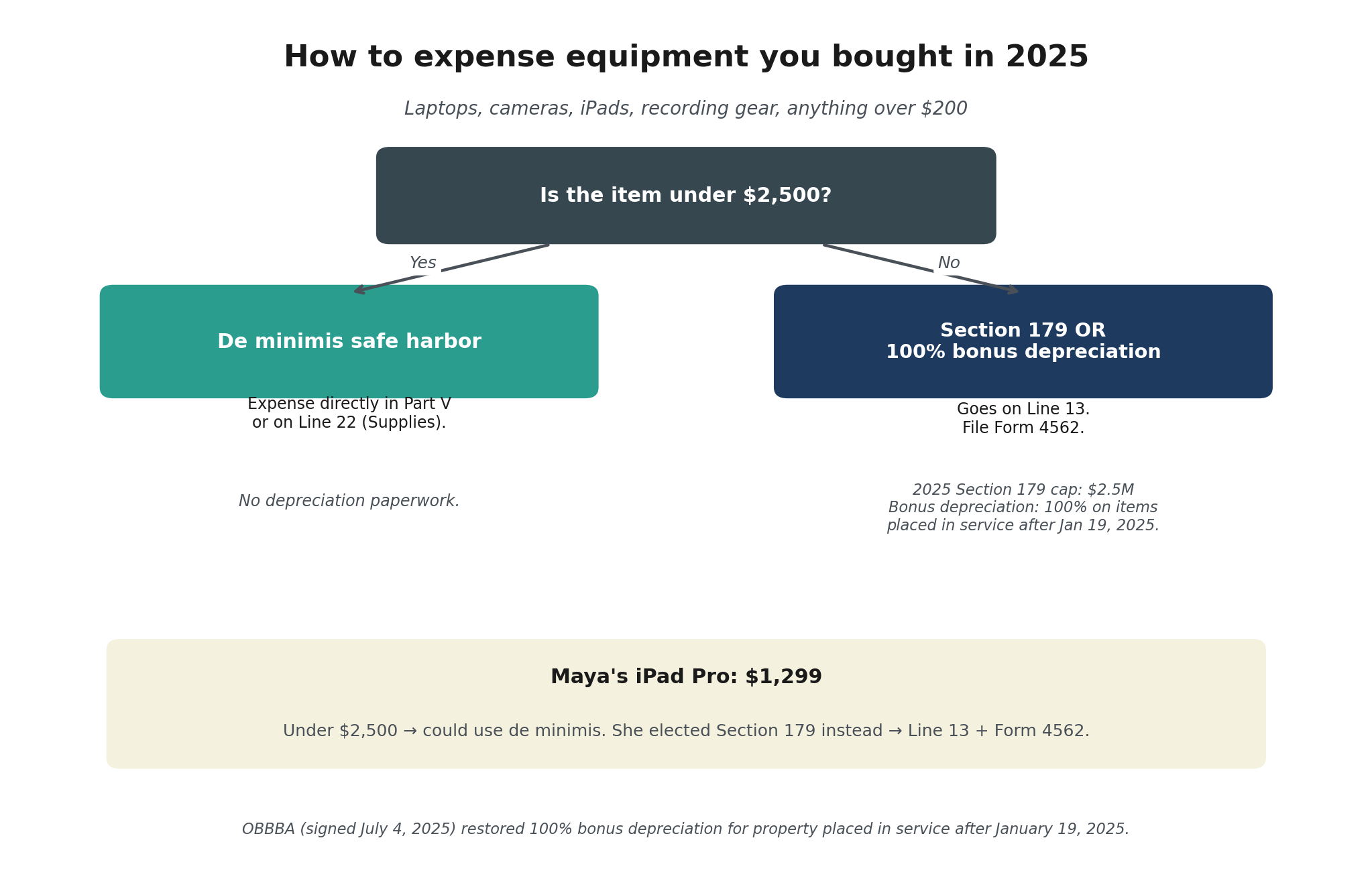
Bought a laptop, camera, iPad, or other equipment for your business in 2025 and it cost more than $200? You have two paths:
- De minimis safe harbor ($2,500 or less per item). Expense it directly. Many freelancers put items under $2,500 in Part V as “Equipment under de minimis safe harbor,” or in Line 22 (Supplies) if it’s a smaller tool. No depreciation paperwork.
- Section 179. Expense the full cost in year one. Goes on Line 13. Requires Form 4562. The 2025 limit is $2,500,000 for total Section 179 deductions (raised from $1,250,000 by the OBBBA), well above what any solo freelancer needs.
The One Big Beautiful Bill Act, signed July 4, 2025, brought back 100% bonus depreciation for property placed in service after January 19, 2025. Most equipment can be fully expensed the year you buy it without using Section 179.
Maya’s iPad Pro at $1,299: she elects Section 179, files Form 4562, puts $1,299 on Line 13.
Line 30: home office
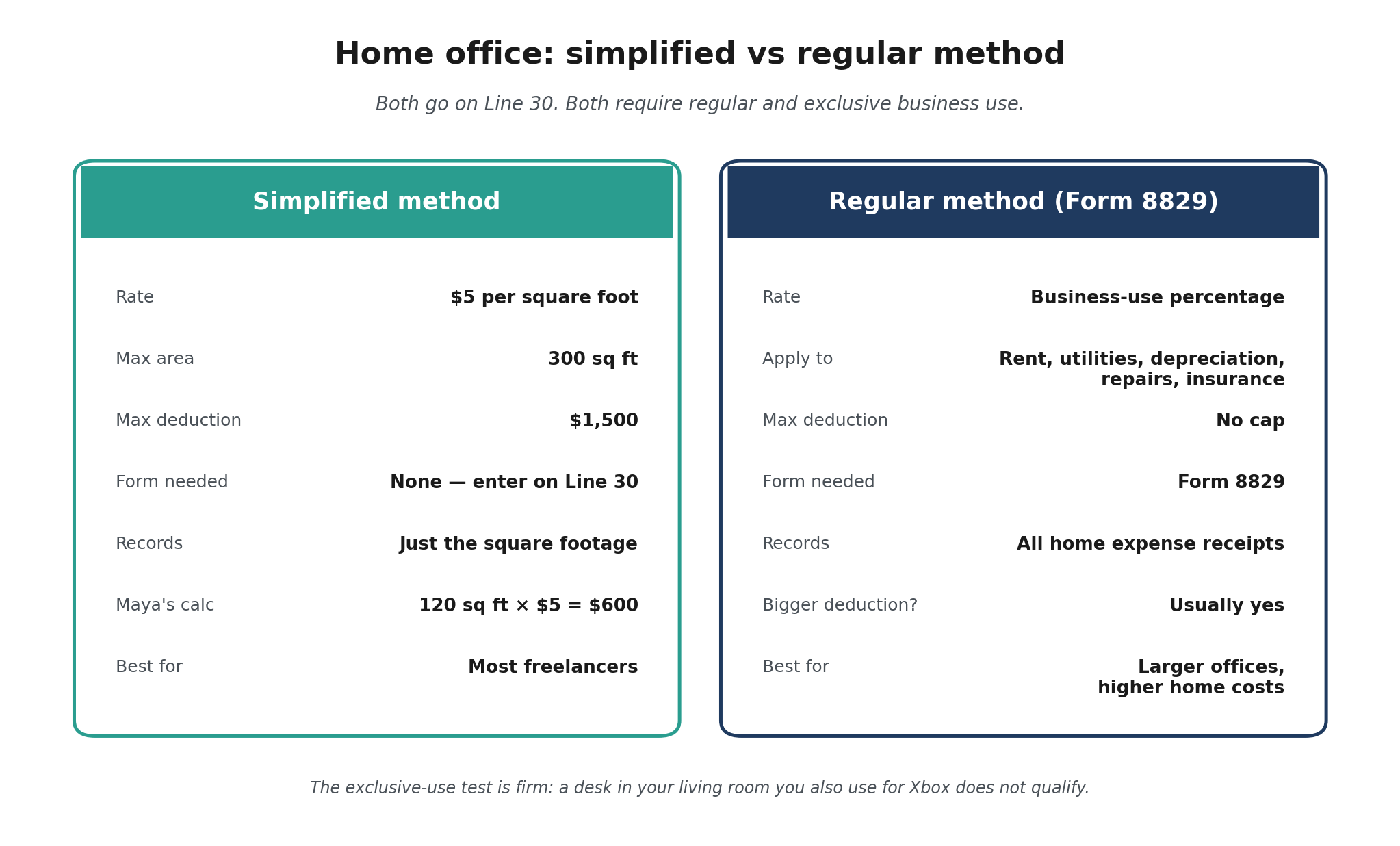
Two ways to claim a home office:
- Simplified method. $5 per square foot, up to 300 square feet. Maximum deduction $1,500. Enter the square footage and the calculation directly on Line 30. No Form 8829 needed.
- Regular method. Work out the business-use percentage of your home, then apply it to actual home expenses (rent, utilities, depreciation, repairs). Requires Form 8829. Bigger deduction in most cases. Also more record-keeping.
To qualify for either, the space has to be used regularly and exclusively for business. A desk in your living room that you also use to play Xbox does not qualify. The IRS is firm on the exclusive-use test.
Maya’s 120 square foot bedroom-converted-to-studio: 120 x $5 = $600 on Line 30.
Part III: Cost of Goods Sold (skip if you sell services)
If you only sell services, leave Part III blank and put zero on Line 4.
If you sell physical products (handmade goods, resold inventory, custom-printed items), Part III works out how much it cost you to produce or buy what you sold. Lines 35 through 41 walk through beginning inventory, purchases, materials, labor, and ending inventory. Line 42 is the result, which carries back to Line 4 in Part I.
For freelance designers, writers, developers, consultants, photographers, marketers, video editors, and virtual assistants, Part III is empty.
Part IV: Vehicle information (only if you used Line 9)
Put a number on Line 9 and you have to complete Part IV. The exception is if you’re filing Form 4562 for vehicle depreciation, in which case the vehicle info goes on Form 4562 instead.
Part IV is short:
- Line 43. The date you placed the vehicle in service for business.
- Line 44a. Total business miles for 2025.
- Line 44b. Commuting miles. Worth noting: commuting is not deductible.
- Line 44c. Other (personal) miles.
- Line 45. Was the vehicle available for personal use? For most freelancers, the answer is yes.
- Line 46. Do you have another vehicle for personal use?
- Line 47a. Do you have evidence to support your deduction? Answer yes only if you actually do.
- Line 47b. Is the evidence written? A mileage log, a tracker app export, calendar entries with addresses count as yes. Your memory does not.
Answer no on 47a and the deduction can be challenged on audit. Answer no on 47b and the deduction can be reduced or denied even with a contemporaneous reconstruction. A mileage tracker app like MileIQ or the built-in tracker in QuickBooks Self-Employed produces the kind of written record the IRS expects.
Part V: Other expenses (Line 48)
This is your itemized “everything else.” For most service freelancers, Part V is the second-biggest expense section after Line 13 or Line 24a. Anything that doesn’t fit elsewhere lives here.
Maya’s Part V:
- Software subscriptions (Adobe, Procreate, Notion): $905
- Domain and website hosting: $312
- Payment processing fees (Stripe): $1,847
- Bank fees (business account): $144
- Conference fees: $1,420
- Internet, business portion (60% of $1,200): $720
Line 48 total: $5,348. This carries to Line 27a in Part II.
Be specific in the descriptions. “Software subscriptions” is fine. “Misc” is not. The IRS reads Part V to spot returns where freelancers dump questionable expenses. Detailed descriptions reduce review risk.
The bottom math: Lines 28 through 32
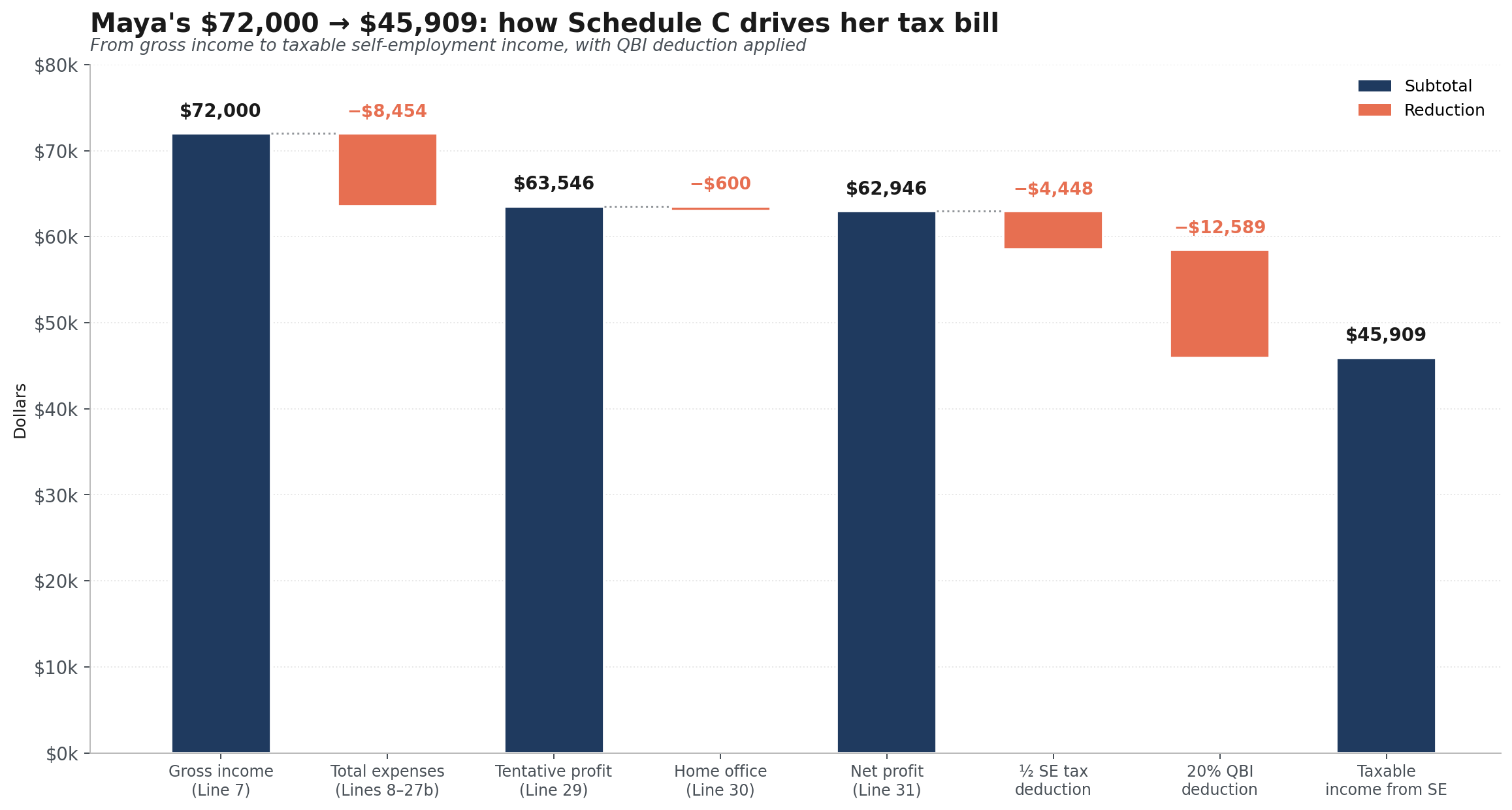
Once Parts II, III, IV, V, and the header are done, the bottom of page one calculates your net profit.
- Line 28. Sum of Lines 8 through 27b. Total expenses before home office.
- Line 29. Line 7 minus Line 28. Tentative profit.
- Line 30. Home office deduction.
- Line 31. Line 29 minus Line 30. This is your net profit. It carries to Schedule 1, Line 3, and to Schedule SE Line 2.
- Line 32. Only matters if Line 31 is a loss. You check 32a (all investment is at risk) or 32b (some not at risk). Most freelancers check 32a.
For Maya: Line 7 = $72,000. Line 28 expenses = roughly $8,454 (mileage $1,288 + software and fees via Part V $5,348 + Section 179 iPad $1,299 + phone $420 + supplies and miscellaneous on dedicated lines $99). Tentative profit Line 29 = $63,546. Home office Line 30 = $600. Net profit Line 31 = $62,946.
That $62,946 carries to Schedule SE for self-employment tax (12.4% Social Security on the first $176,100 for 2025, plus 2.9% Medicare with no cap, applied to 92.35% of net profit). It also carries to Schedule 1, Line 3, which feeds Form 1040 as part of total income. Maya’s self-employment tax: about $8,896. She also gets to deduct half of that ($4,448) on Schedule 1, Line 15. If you’re staring at a number like Maya’s and wondering whether you should have been setting more aside all year, our freelancer tax set-aside calculator walks through the percentages by income level. It’s also the same number that feeds your estimated quarterly tax payments via Form 1040-ES.
One more thing your Line 31 net profit drives: the Qualified Business Income (QBI) deduction under Section 199A. If your taxable income is under the 2025 thresholds ($197,300 single / $394,600 joint), you can deduct up to 20% of your Schedule C net profit on Form 1040 before figuring federal income tax. That’s separate from the half-SE-tax deduction and separate from your business expenses on Schedule C itself. The OBBBA made this deduction permanent and adjusted the phase-in ranges. Tax software calculates it automatically once you finish Schedule C. For Maya at $62,946, that’s potentially a $12,589 deduction stripped off her taxable income before federal tax is applied. It’s the single biggest reason Schedule C is worth doing carefully.
Four 2025 changes that catch people out
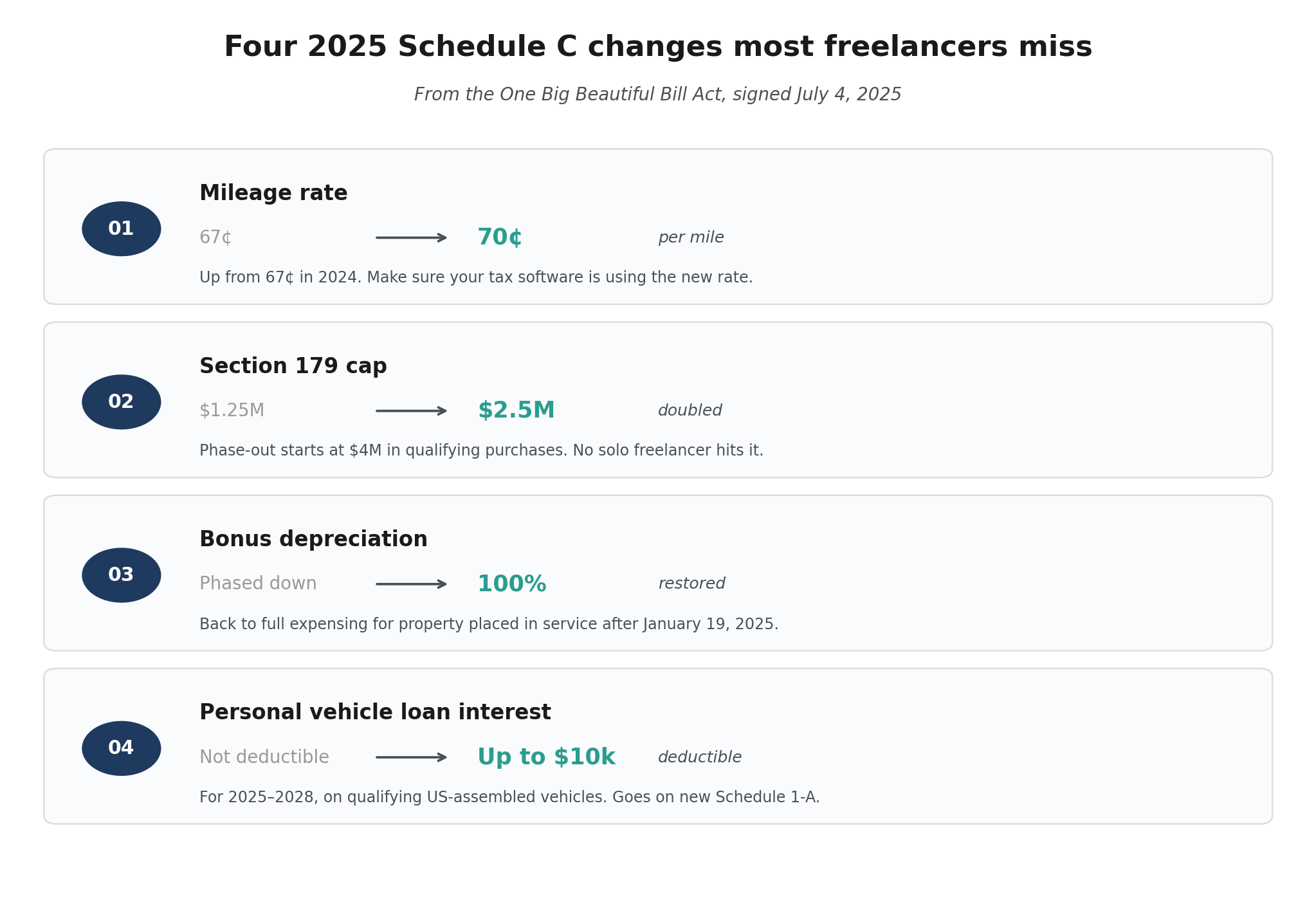
The 2025 Schedule C looks almost identical to 2024 on the surface. Underneath, there are real changes. The One Big Beautiful Bill Act (OBBBA), signed July 4, 2025, made a few updates worth knowing:
- The standard mileage rate is 70 cents per mile, up from 67 cents in 2024. Make sure your tax software is using the right rate.
- 100% bonus depreciation is back for qualified property placed in service after January 19, 2025. Equipment you bought late in the year can be fully expensed via bonus depreciation as an alternative to Section 179.
- Section 179 limit doubled to $2,500,000. The OBBBA raised the cap from $1,250,000, with phase-out starting at $4,000,000 in qualifying purchases. No solo freelancer hits that ceiling, but it confirms equipment expensing is wide open for 2025.
- Personal-use vehicle loan interest is now deductible. For 2025 through 2028, up to $10,000 of interest on a qualifying new US-assembled vehicle loan goes on the new Schedule 1-A. Phase-outs start at $100,000 MAGI single / $200,000 joint. Business-use vehicle interest stays where it was on Schedule C Line 16b. Don’t claim the same interest twice.
- Tip deduction on Schedule 1-A, if your occupation qualifies. Self-employed workers in IRS-listed tipped occupations can deduct up to $25,000 of qualified tips on Schedule 1-A for 2025 through 2028. Most knowledge-work freelancers won’t qualify. Creators or service providers receiving platform tips might.
Most tax software handles these automatically. Filling out the form by hand or using older software? Double check.
The five-minute Schedule C readiness check
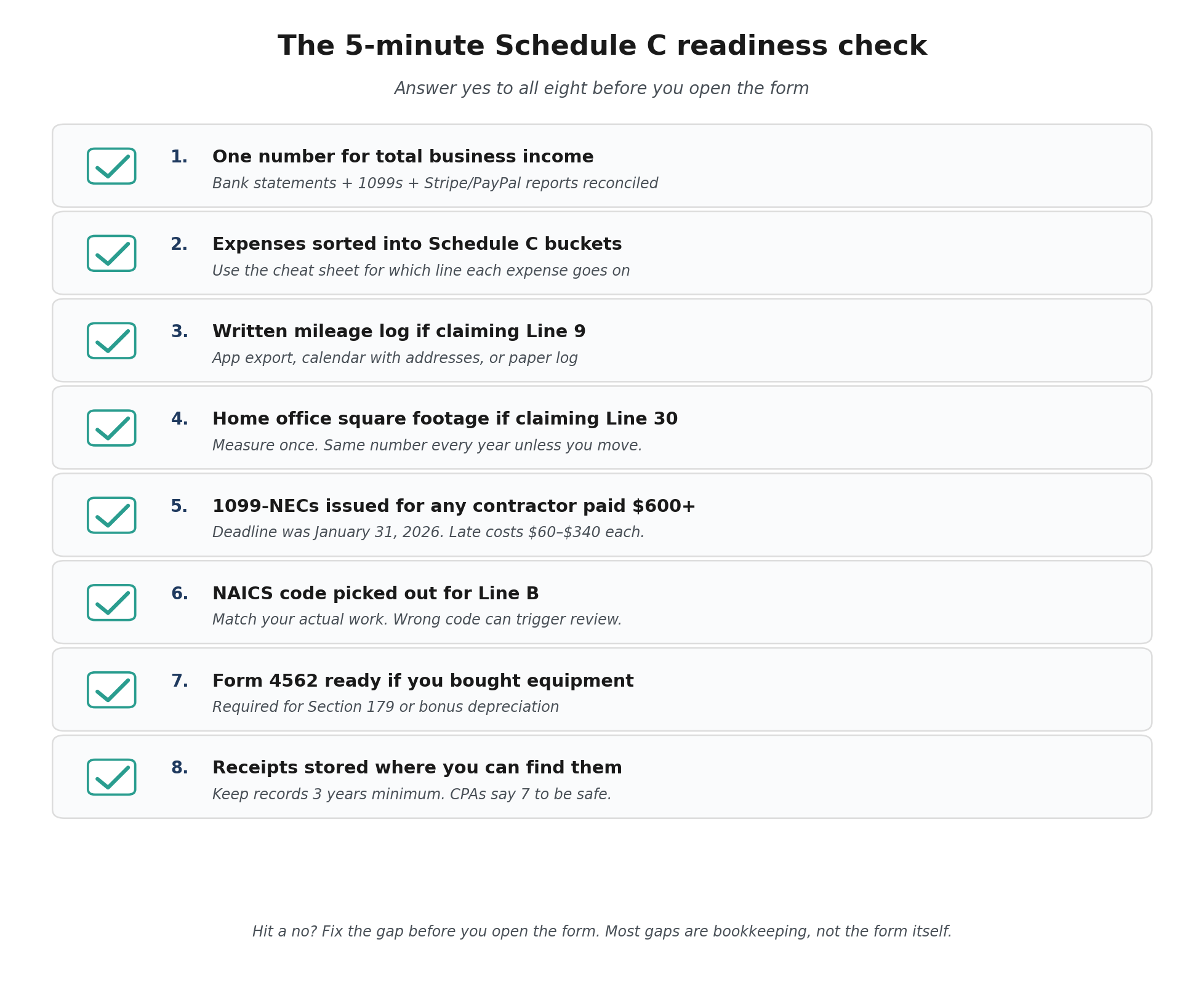
Before you start filling anything in, run through this list. Answer yes to all of them and you’re ready. Hit a no, and fix the gap before you open the form.
- Do I have one number for total business income, including non-1099 payments? (Bank statements + 1099s + Stripe/PayPal reports reconciled.)
- Do I have my expenses sorted into Schedule C buckets? (Use the table above.)
- Do I have a written mileage log if I’m claiming Line 9? (App export, calendar with addresses, paper log; any of these.)
- Do I know my home office square footage if I’m claiming Line 30?
- Did I pay any contractor $600 or more in 2025, and did I issue 1099-NECs?
- Do I have a NAICS code picked out for Line B?
- Did I buy equipment in 2025 that I want to expense via Section 179 or bonus depreciation? (If yes, Form 4562.)
- Have I stored receipts and supporting documents somewhere I can find them? The IRS recommends keeping records for at least 3 years from the filing date, longer if you under-reported by more than 25%. Most CPAs say 7 years to be safe.
Stuck on item 1 or item 2? The gap is bookkeeping, not the tax form. See our accounting software guide for tools that produce a clean Schedule C-ready P&L.
Tools that auto-generate Schedule C
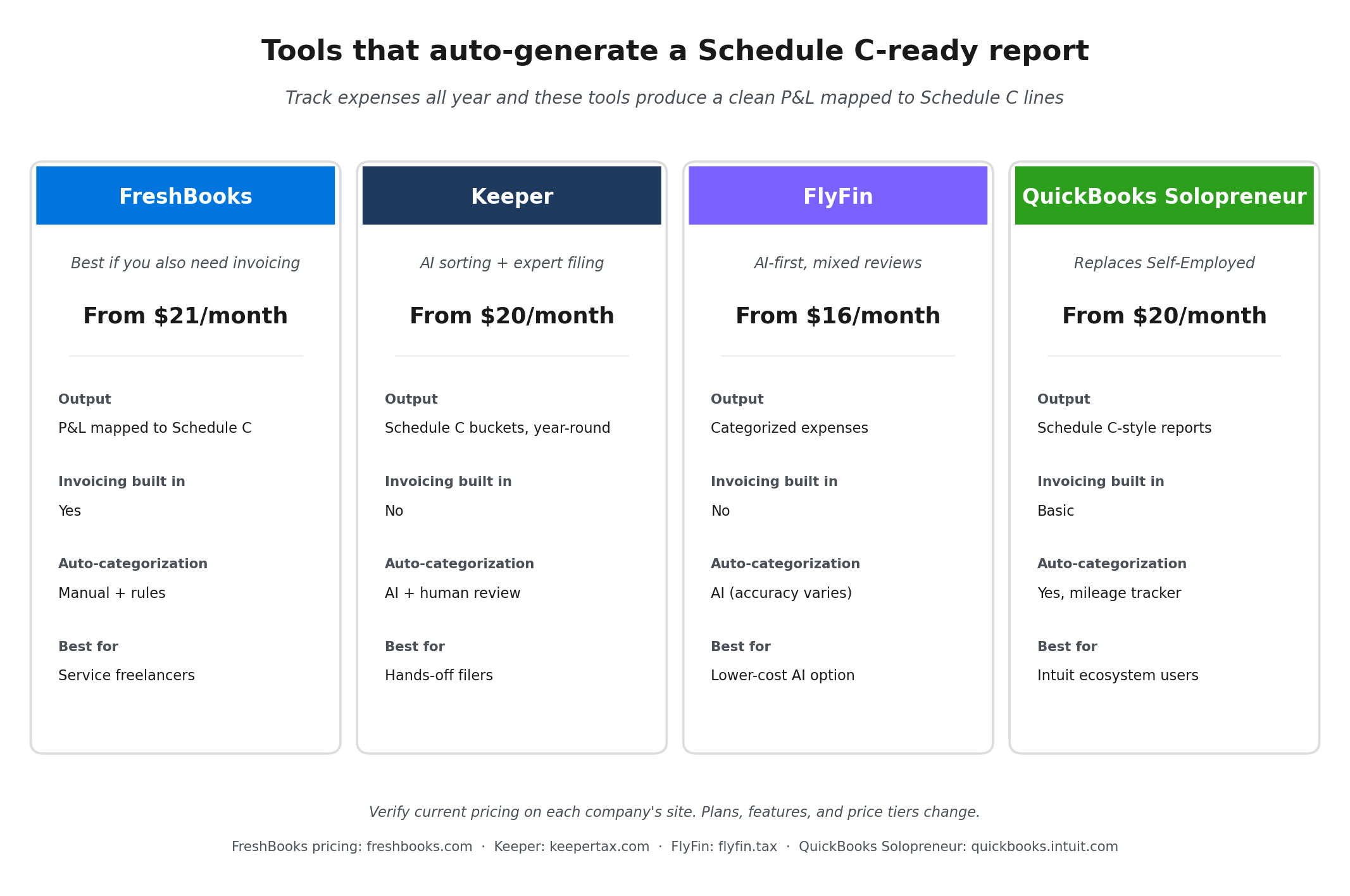
Track expenses in a real bookkeeping tool all year and the tool can usually export a Schedule C-ready report or feed your tax software directly. The freelancer-focused options:
- FreshBooks. Exports a Profit and Loss report that maps cleanly to Schedule C lines. A strong choice if you also need invoicing in the same tool. We compared it head-to-head with Xero in our FreshBooks vs Xero 2026 review. Pricing starts at $21/month for Lite (verify current pricing on freshbooks.com).
- Keeper. Sorts expenses against Schedule C buckets automatically and connects to expert tax filing. Worth $20/month depends on your transaction volume and how much you’d otherwise pay a CPA. Our full Keeper Tax review for 2026 goes through what it actually does well and where it falls short.
- FlyFin. Uses AI to scan transactions and assign Schedule C categories. User reviews are mixed, especially around the chatbot’s accuracy and the upgrade prompts. We covered the good and the bad in our honest FlyFin review. Trying to decide between the two AI-first options? Our FlyFin vs Keeper Tax comparison is built from real user reviews on both sides.
- QuickBooks Solopreneur. Replaces the discontinued QuickBooks Self-Employed. Generates Schedule C-style reports.
For the wider category comparison, see our freelancer accounting tools roundup and our invoicing tools roundup. We’ve also written about avoiding the April tax shock and managing freelance cash flow.
Start Your Free Trial with FreshBooks
Get the Schedule C prep checklist

One page. Every line of Schedule C, with the expense categories you most likely use, plus the documents to gather before you open the form. Save it to your desktop, print it, work through it. The gap between “I owe $7,000 and I don’t know why” and “I owe $7,000 and I have the paperwork to back it up” is a checklist.
Frequently Asked Questions
Do I need to file Schedule C if I made under $600?
Yes, if you had any net self-employment earnings of $400 or more, you file Schedule C. The $600 threshold is the rule for whether your client has to send you a 1099-NEC. It’s not a rule about whether your income is reportable. All business income is reportable, regardless of whether you got a tax form for it. Earned $300 in side freelance work and that’s your only self-employment income? You don’t have to file Schedule C, but you may still need to report the income elsewhere on your return.
What’s the difference between a 1099 and Schedule C?
A 1099-NEC is a form your client sends you (and the IRS) showing how much they paid you. Schedule C is the form you file with your tax return showing your total business income (from all sources, 1099 or not) and your expenses. You receive 1099s. You file Schedule C. The 1099 income flows into Line 1 of Schedule C along with any non-1099 business income.
Can I file Schedule C without a separate business bank account?
Yes. The IRS doesn’t require a separate business bank account for sole proprietors. Skip it and everything gets harder. Mixing personal and business in one account means you’re either sorting transactions for hours at tax time or paying a bookkeeper to do it. A free business checking account at most banks fixes the problem. With a single-member LLC, mixing accounts can also weaken the liability protection of the LLC structure.
How much should I have set aside for the tax I’ll owe on my Schedule C profit?
Most freelancers under $100k in net profit should set aside 25 to 30 percent of every payment they receive. That covers federal income tax (10 to 24 percent depending on your bracket), self-employment tax (15.3 percent up to the Social Security wage base), and a buffer for state tax. People who set aside 20 percent often end up short by a few thousand dollars in April. We break down the actual math by income level in our freelancer tax set-aside guide.
Where does my SEP IRA or Solo 401(k) contribution go on Schedule C?
It doesn’t. Self-employed retirement contributions for yourself go on Schedule 1, Line 16. Not Schedule C. Line 19 (Pension and profit-sharing plans) on Schedule C is only for contributions you make on behalf of employees. Your own SEP IRA or Solo 401(k) contribution reduces your AGI through Schedule 1.
What if I had a loss on Schedule C?
Expenses higher than income means Line 31 is negative. Check Line 32a (“All investment is at risk”) if your money is on the line for any business debt, which is true for almost every solo freelancer. The loss reduces your other income on Form 1040. Watch out for the IRS hobby loss rules: an activity that has produced losses for several years and never made a profit can be reclassified by the IRS as a hobby, in which case the losses aren’t deductible. The general guideline is profit in 3 of 5 years.
Do I need to fill out Schedule C myself, or will tax software do it?
Tax software (TurboTax Self-Employed, TaxAct Self-Employed, FreeTaxUSA, H&R Block, Keeper, FlyFin) walks you through Schedule C with interview-style questions and fills the form behind the scenes. You still need to know what’s a business expense, which line it belongs on, and how to back it up. The software does math. You do the categorization. This walkthrough is the categorization layer. For a closer look at the AI-driven options that handle Schedule C end-to-end, our FlyFin vs Keeper Tax comparison covers what each one actually delivers.
When is Schedule C due?
April 15, 2026 for tax year 2025. Request a six-month automatic extension via Form 4868 and the filing deadline pushes to October 15, 2026. The extension is a filing extension, not a payment extension. Any tax you owe is still due April 15, 2026. Late payment triggers interest and penalties from that date.
What’s the most common Schedule C mistake?
Underreporting Line 1 income because the freelancer only added up the 1099s they received and forgot the cash, Stripe, PayPal, or Venmo payments that didn’t generate a 1099. The IRS automated matching system catches gaps between the 1099-NEC and 1099-K data it receives from clients and platforms and what you report on Line 1. Match or beat the 1099 totals on Line 1, always.
This article is for informational purposes only and is not tax or legal advice. Tax laws change. Verify all figures, deadlines, and rules at IRS.gov before filing, and talk to a CPA or enrolled agent for advice specific to your situation.
About the author
Gareth is an entrepreneur based in Dubai and the founder of AI Finance Tools for Freelancers. He’s not a CPA or a bookkeeper. He built this site because he couldn’t find honest, thorough reviews of AI finance tools written for freelancers. Every guide is researched from real user reviews, official IRS documentation, and expert sources.