
The 1099 thresholds changed twice in eighteen months. Here is what you owe in 2026, what shows up in your mailbox, and the math on a real freelancer with three clients and a Venmo account.
Three clients paid you $1,500 each in 2026. None of them sent you a 1099. You also got paid $4,200 through Venmo across 38 transactions. No 1099-K either. You still owe federal income tax and self-employment tax on every dollar of that $8,700.
The One Big Beautiful Bill Act (Public Law 119-21), signed into law on July 4, 2025, rewrote the 1099 reporting rules. Most articles about it are either flat wrong or written for accountants who file 400 1099s a year. You are filing one tax return. Two things matter to you. What forms will arrive in your mailbox in early 2027. And what you owe whether or not those forms show up.
This guide covers both. It uses the IRS’s own published thresholds from Publication 1099 (2026) and the IRS news release IR-2026-03 issued January 8, 2026. No other blog posts as sources. No interpretations of interpretations.
What changed in 2026, in plain English
Two thresholds moved in opposite directions. One went up. One went back to where it was before 2022.
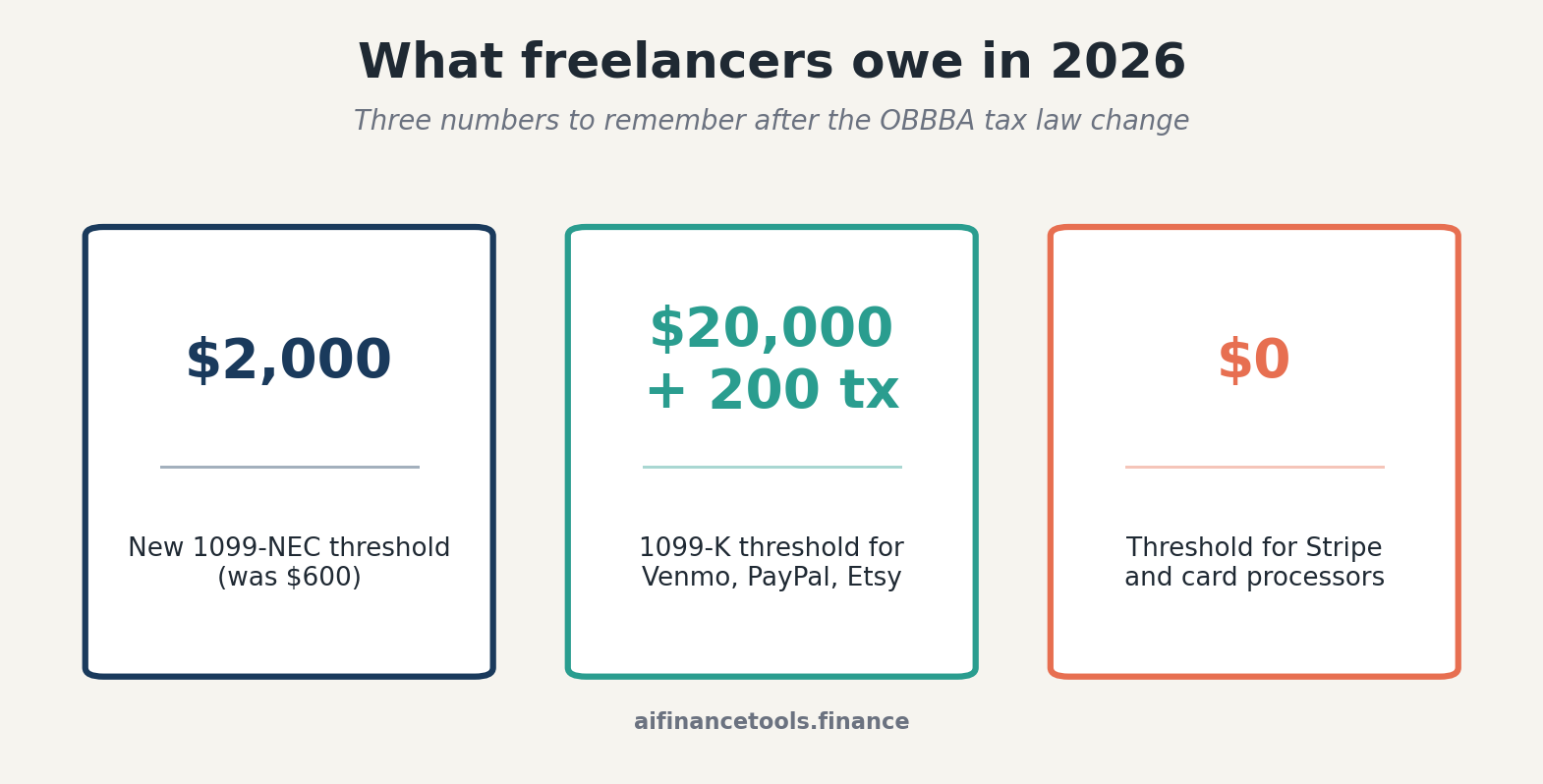
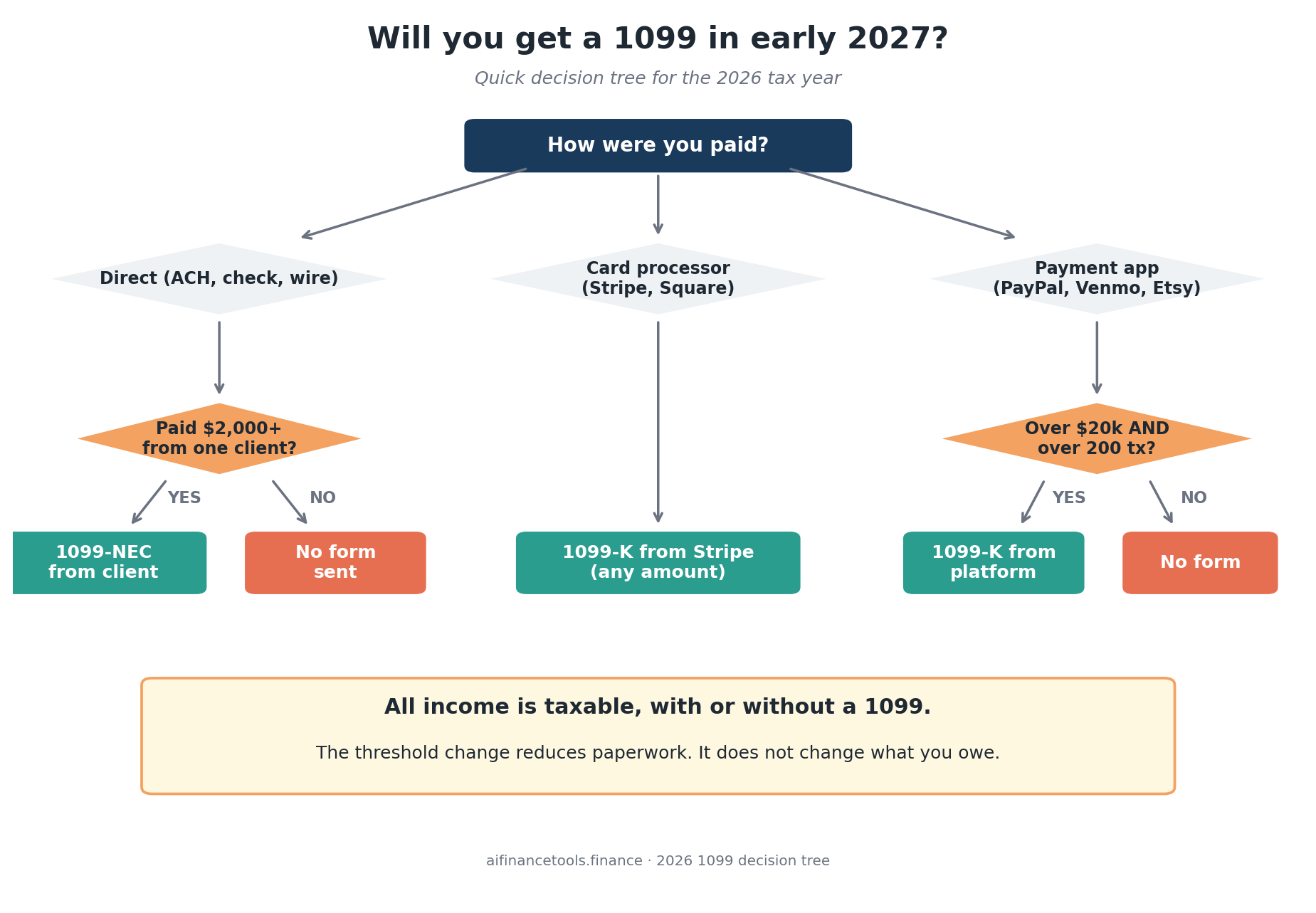
Form 1099-NEC and 1099-MISC threshold went up. The old $600 trigger had been in place since the 1950s. For payments made after December 31, 2025, your clients only have to issue you a 1099-NEC if they paid you $2,000 or more during the calendar year. The same threshold applies to 1099-MISC for things like rent payments and prize money. The IRS confirms this in Publication 1099 (2026): “For tax years beginning after 2025, the minimum threshold amount for reporting certain payments… increased to $2,000.”
Form 1099-K threshold reverted to the old rule. The American Rescue Plan Act of 2021 had set the 1099-K threshold at $600 with no transaction minimum. That never fully took effect because the IRS kept delaying it. The OBBBA killed it permanently. The threshold is back to gross payments exceeding $20,000 along with more than 200 transactions in a calendar year. Both conditions must be met. Retroactive to 2022.
The “both conditions” part trips most freelancers up. If you got paid $50,000 through Venmo across 80 transactions, no 1099-K. The transaction count fails. If you got paid $8,000 across 250 transactions, also no 1099-K. The dollar amount fails. This is where most of the confusion lives right now.
The 2026 thresholds at a glance
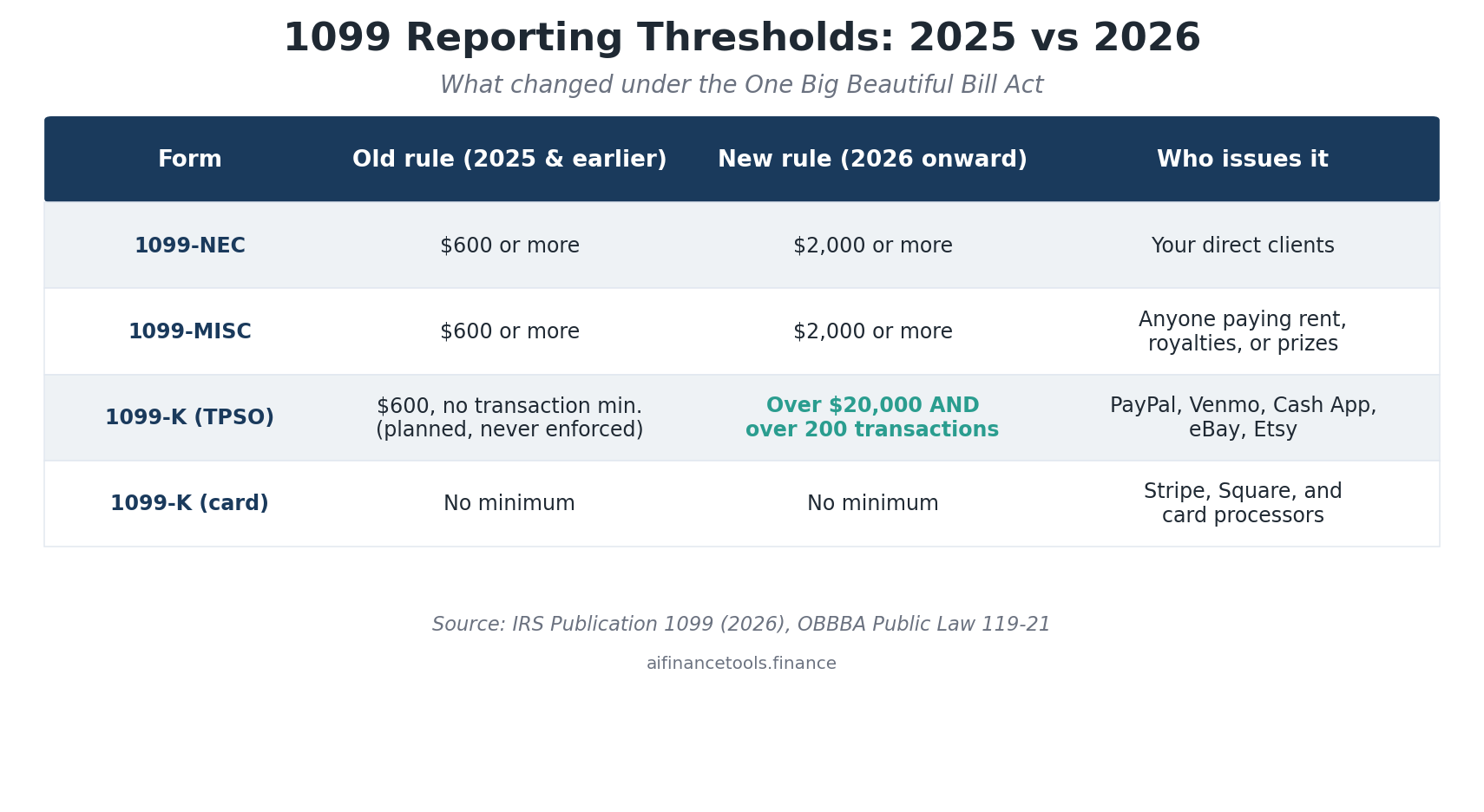
That last row trips most freelancers up. If you take payments through Stripe, Square, or any merchant card processor, there is no threshold. They issue a 1099-K for any amount. Per IRS guidance, the $20,000 and 200 transaction rule only applies to third-party settlement organizations, a specific legal category that includes payment apps and online marketplaces. It does not include card processors when they are processing card payments directly.
1099-NEC threshold 2026: the $2,000 rule and what it means for you
1099-NEC threshold 2026: the $2,000 rule and what it means for you
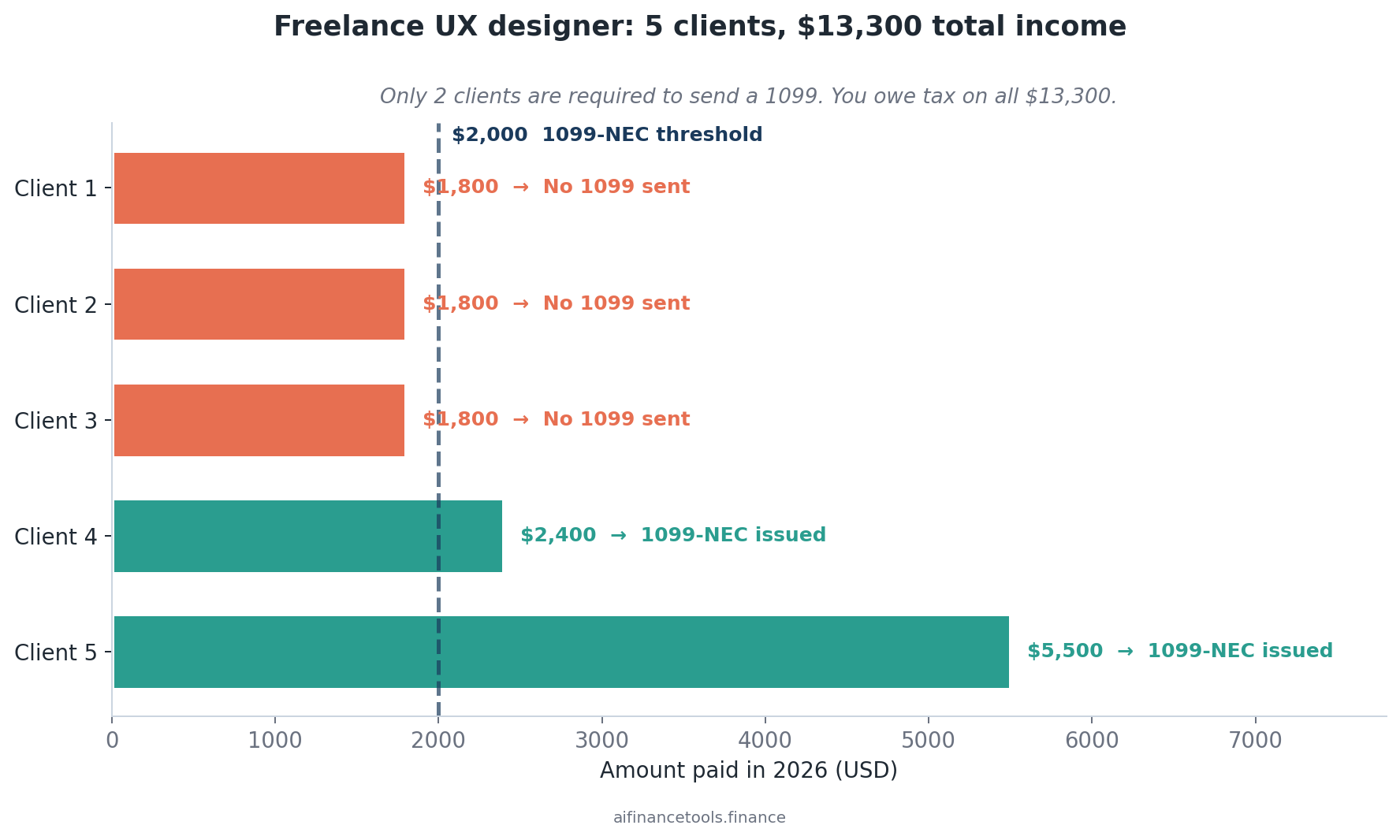
3,300 in income, but only two clients are required to send a 1099.Picture this. You are a freelance UX designer. You took on five projects in 2026. Three clients each paid you $1,800. One paid you $2,400. One paid you $5,500. Your total income from these clients is $13,300.
How many 1099-NECs will you receive in early 2027? Two. The $2,400 client and the $5,500 client. The other three are below the new $2,000 threshold and have no obligation to send you a form.
How much income do you owe tax on? $13,300. Every dollar. The threshold change affects who has to file paperwork. It does not change what counts as taxable income.
This is the single most dangerous misunderstanding circulating right now. People on Reddit and on X have read headlines about the $2,000 threshold and concluded that small payments are “tax free” or “below the radar.” They are wrong. The IRS news release on January 8, 2026 was direct about it: “The IRS reminds taxpayers that backup withholding and reporting thresholds do not affect whether income is taxable.” If you get audited, the IRS will pull your bank statements. They do not care whether a 1099 was issued.
What about the new boxes on the form for tips and overtime?
The IRS revised both 1099-NEC and 1099-MISC for 2026 to add new boxes. Standard nonemployee compensation moved from Box 1 to Box 1a on the 1099-NEC. New boxes were added for cash tips (Box 1b), Treasury Tipped Occupation Codes (Box 1c), and overtime compensation (Box 1d). These tie to the OBBBA’s “no tax on tips” deduction, which lets eligible workers deduct up to $25,000 of qualified tips through 2028. For most freelancers in design, writing, development, or consulting, this does not apply. You are not in a “customarily and regularly tipped occupation” as defined by the Treasury Tipped Occupation Code list. If you do photography or videography for events and receive tips, that is the rare exception worth asking your CPA about.
Will the threshold stay at $2,000 forever?
Will the threshold stay at $2,000 forever?
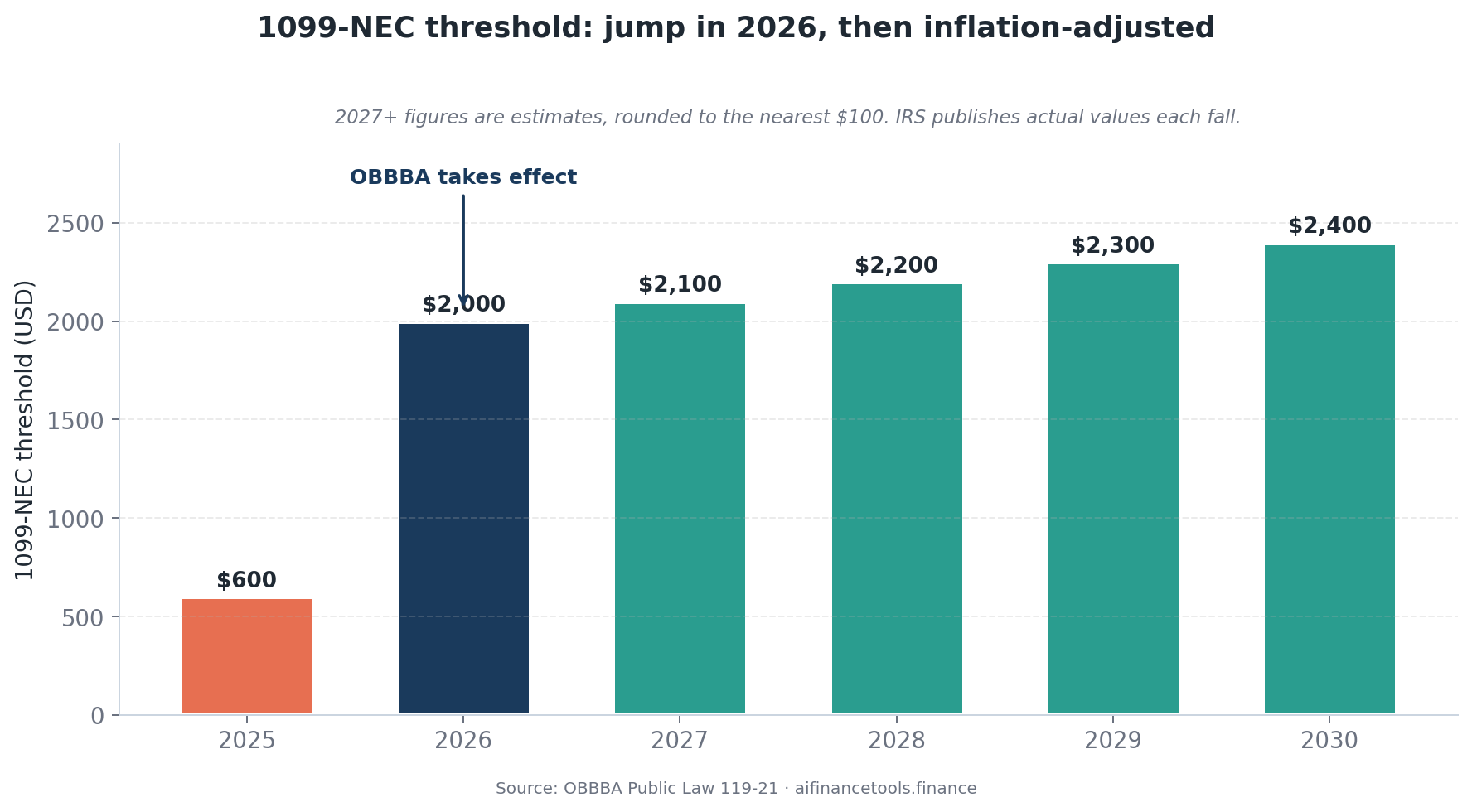
00.No. Starting in 2027, the $2,000 threshold will be adjusted for inflation each year and rounded to the nearest $100. The IRS publishes the next year’s threshold in late fall. The 1099-K threshold of $20,000 plus 200 transactions is not indexed and stays put indefinitely unless Congress changes it.
1099-K threshold 2026: the $20,000 and 200 transaction rule
Form 1099-K reporting is governed by Section 6050W of the Internal Revenue Code, which the OBBBA amended in 2025. The form reports payments processed through a payment platform. PayPal goods and services. Venmo business. Cash App for Business. Stripe. Square. eBay. Etsy. Amazon. Anywhere a third party stands between you and your customer’s money.
The OBBBA reverted the 1099-K threshold to its pre-2022 level: gross payments exceeding $20,000 along with more than 200 transactions. Both, not either. This was retroactive to 2022, which means if you got a 1099-K for 2024 or 2025 under the lower thresholds, you should have already seen the rules ease.
Here is the catch most freelancers hit. The 1099-K threshold for TPSOs (PayPal, Venmo, Cash App) is over $20,000 and over 200 transactions. The threshold for credit card processors (Stripe, Square) is zero. If your client pays your $1,200 invoice through Stripe Checkout, Stripe will issue a 1099-K for that one transaction. If your client pays the same invoice through PayPal Friends and Family, PayPal will not issue anything. One thing worth flagging: that payment method is against PayPal’s terms of service for business transactions anyway.
$2,000 1099 threshold confusion: NEC vs K
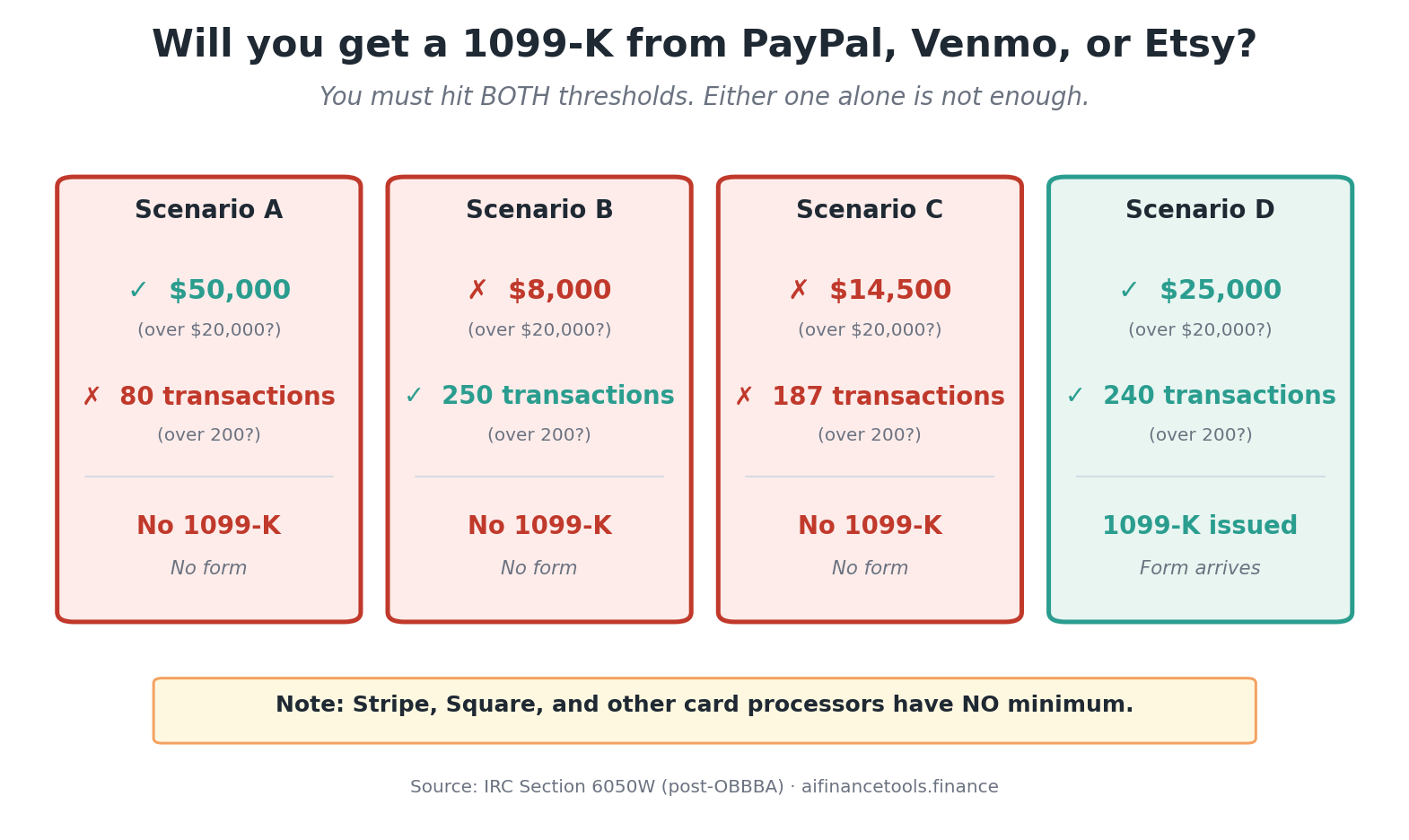
You will see “the $2,000 threshold” and “the new threshold” used interchangeably online. They are not the same thing. The $2,000 figure is the 1099-NEC and 1099-MISC threshold. The 1099-K threshold is over $20,000 plus over 200 transactions. There was a planned $2,000 1099-K threshold floating around in earlier reporting that never became law. Anyone telling you the 1099-K threshold is now $2,000 is reading old draft proposals.
The double-reporting problem
You bill a client for $3,000. They pay through Stripe. Stripe issues you a 1099-K. The client also issues you a 1099-NEC because they directly paid you $3,000. Now the IRS sees $6,000 of income that was actually $3,000.
This was a known issue under the old rules and it gets worse with more freelancers using Stripe. The fix is on your tax return. You report the actual gross income on Schedule C, not the sum of the 1099s. If the IRS flags the discrepancy, you respond with documentation showing the duplicate. To prevent the problem, ask any client paying you over $2,000 by card or processor to NOT also issue a 1099-NEC. Most accounting departments understand this. Some do not. Track it yourself in your bookkeeping. If you need a starting point on that, our guide on tracking business expenses as a freelancer walks through the basic income and expense ledger that prevents this kind of mess.
New 1099 rules 2026: a worked example
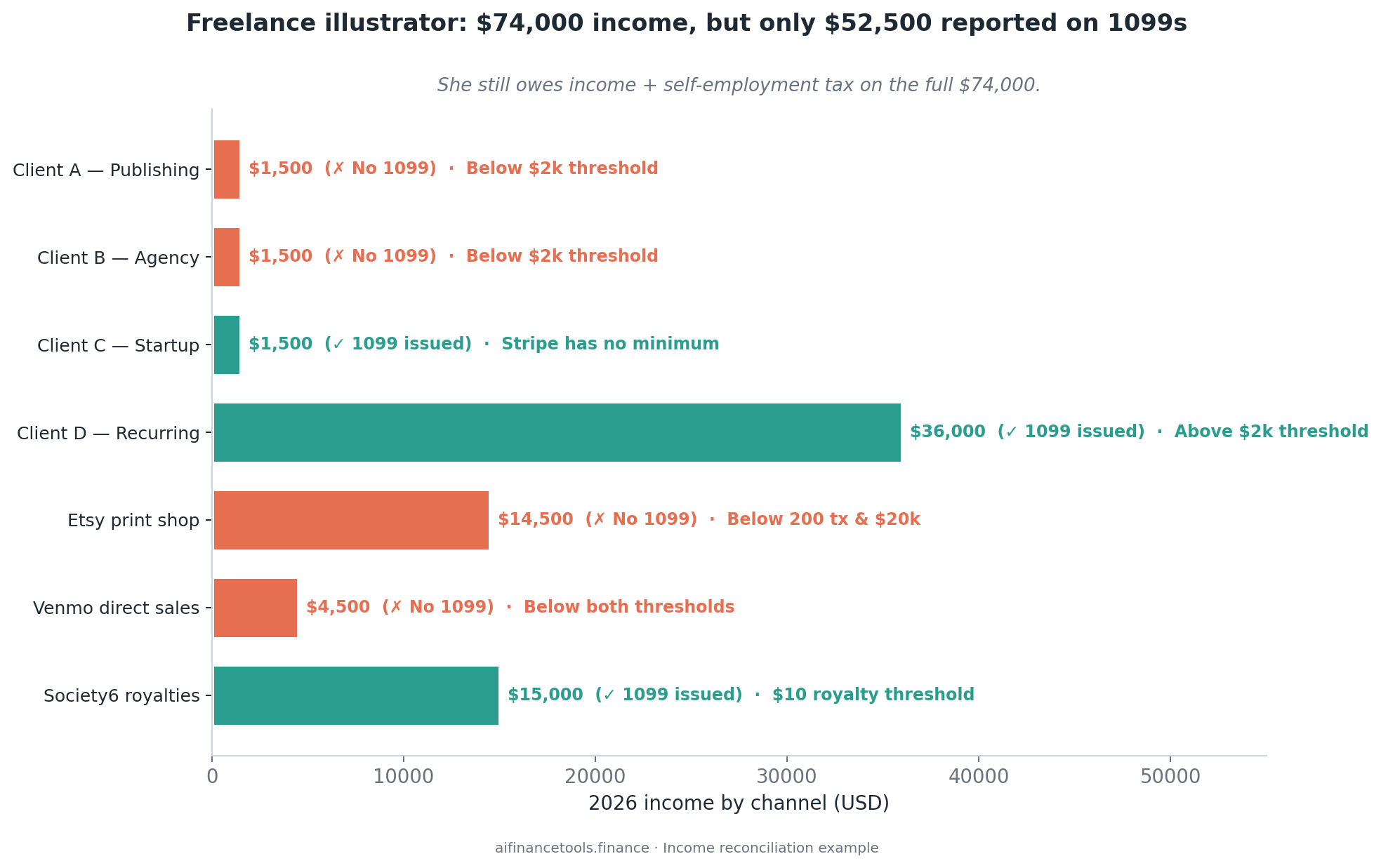
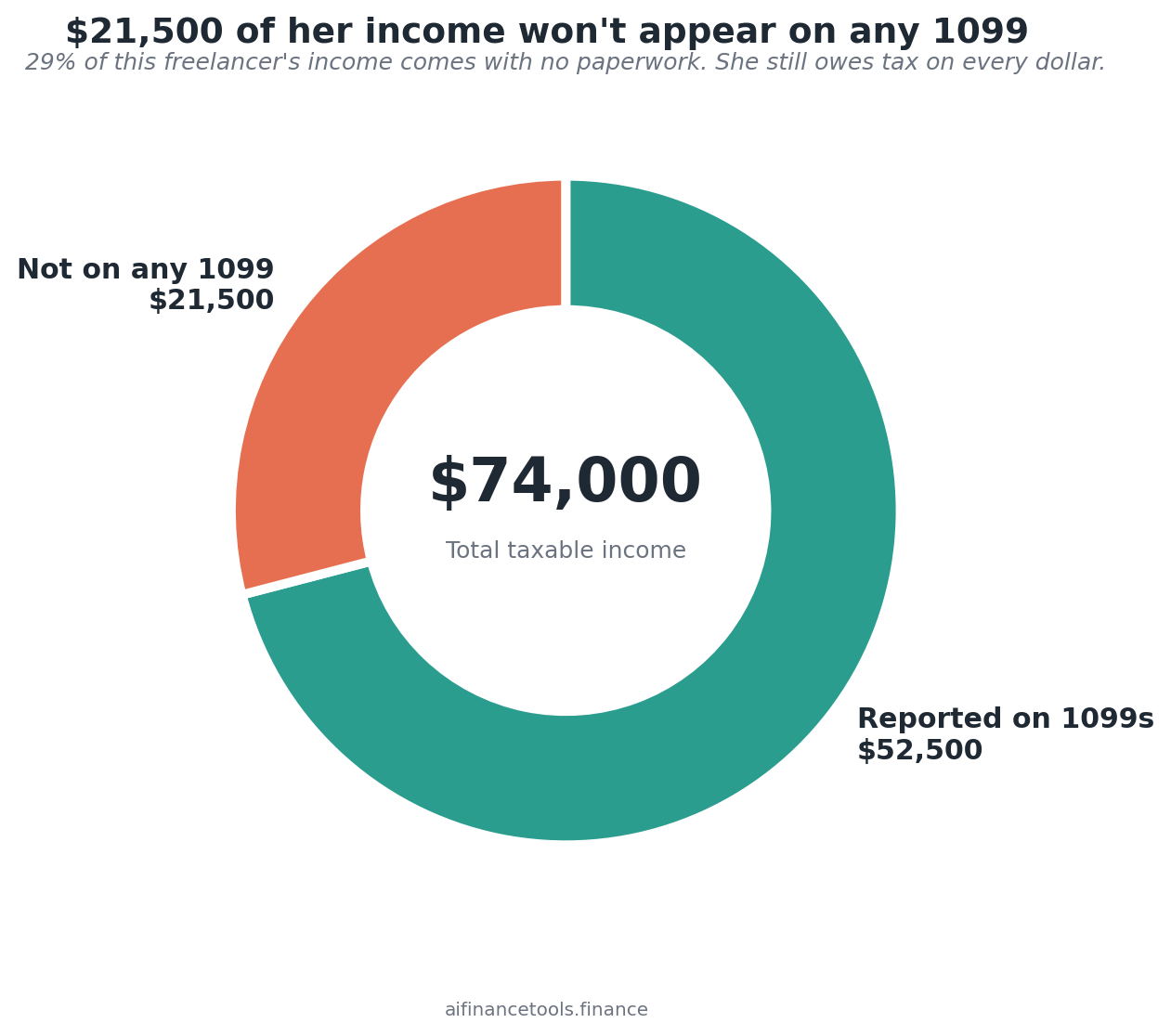
Meet a freelance illustrator. She earned $74,000 in 2026 across these channels:
- Client A (publishing house) paid $1,500 by ACH bank transfer for a book cover.
- Client B (marketing agency) paid $1,500 by ACH for a campaign illustration.
- Client C (small startup) paid $1,500 through Stripe for branding work.
- Client D (recurring) paid $36,000 across the year through ACH.
- Etsy print shop generated $14,500 across 187 transactions.
- Venmo business profile received $4,500 from 22 print collectors who paid directly.
- Print-on-demand site (Society6) paid $15,000 in royalties.
Forms she will receive in early 2027:
- Client D: 1099-NEC for $36,000. Direct payments above the $2,000 NEC threshold.
- Stripe: 1099-K for $1,500 (the Client C payment). No threshold for card processors.
- Society6: 1099-MISC for $15,000 in box 2 (royalties). The royalty threshold is $10, not $2,000.
Forms she will NOT receive:
- Clients A and B. Both below the $2,000 1099-NEC threshold.
- Client C. The startup may issue a 1099-NEC out of habit, but they do not have to. The Stripe 1099-K already covers it.
- Etsy. $14,500 is below the $20,000 TPSO threshold. The 187 transactions are below the 200 minimum. Both fail. No form.
- Venmo. $4,500 across 22 transactions sits below both thresholds. No form.
Total reported on her 1099s: $52,500. Total actual income: $74,000. The $21,500 difference is real income she still owes tax on, including federal income tax, self-employment tax of 15.3% on her net earnings (after the deductible half), and state tax wherever she lives.
If she only reports the income on the 1099s and skips the rest, she is committing tax fraud. If she gets audited, the IRS pulls her bank statements, sees the deposits, and assesses the back tax plus penalties plus interest. The audit risk for self-employed filers earning $25,000 to $200,000 was about 0.4% in recent IRS data. Low, but real enough to worry about if you are under-reporting on purpose.
1099 reporting requirements 2026: what you actually have to do
You receive 1099s. You do not file 1099s as a freelancer (with one exception, covered below). The forms come to you. Your job is reconciliation.
Step 1: Track your gross income yourself
Half your clients in 2026 will not send you anything. Waiting for 1099s to figure out what you earned is no longer an option. You need a running list.
Log every payment as it arrives. Date received. Client name. Gross amount (before any platform fees). Payment method. Whether it was for services or product sales. A spreadsheet works fine for under 50 transactions a year. Beyond that, use accounting software that pulls bank and Stripe data automatically. Our breakdown of accounting software for freelancers covers the trade-offs.
Step 2: Reconcile against the 1099s when they arrive
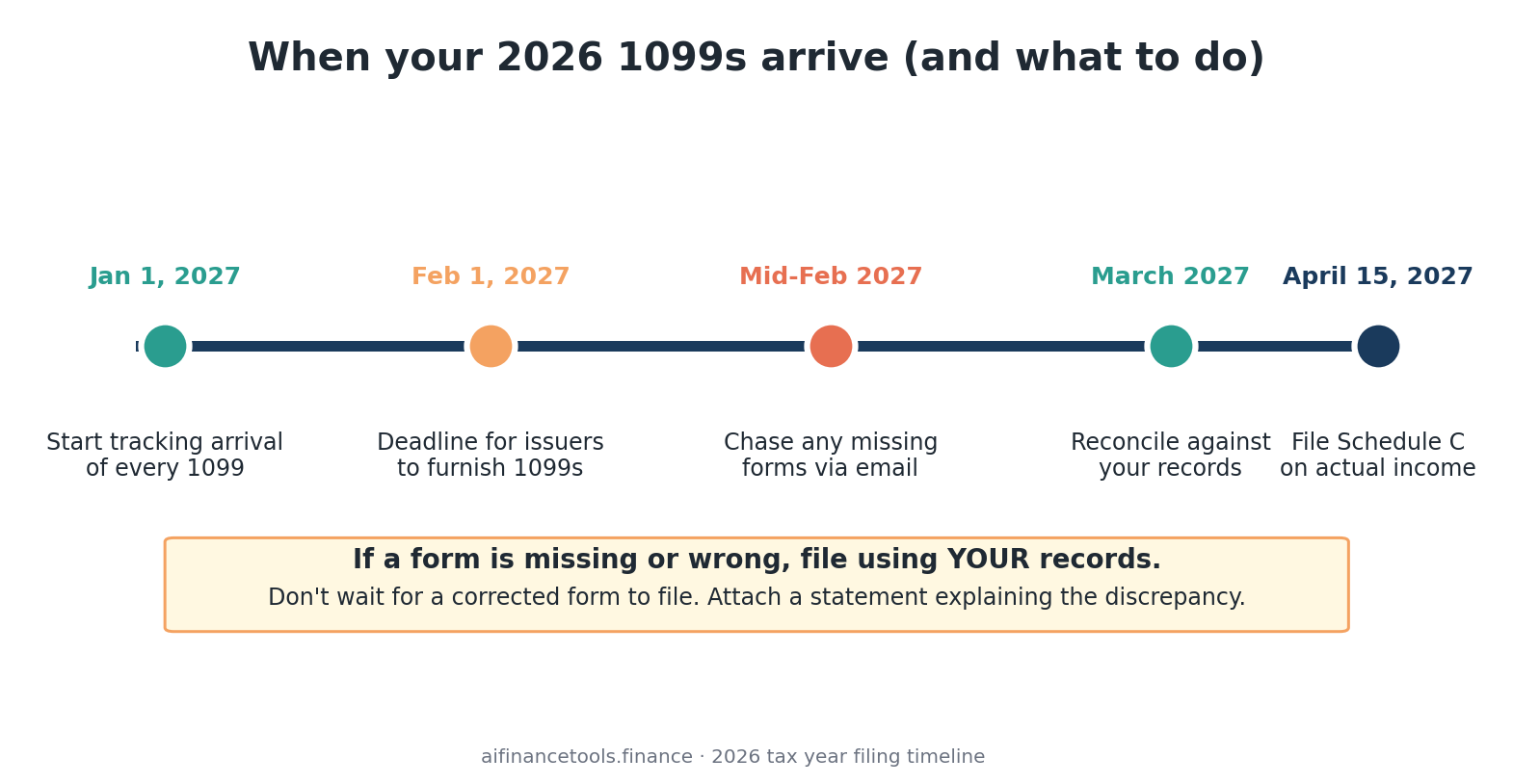
1099-NEC forms must be furnished to recipients by January 31 of the following year. For the 2026 tax year, the deadline shifts to February 1, 2027 because January 31 falls on a Sunday. 1099-K forms must also be furnished by January 31. Most arrive in your mailbox or email inbox by early February.
When they arrive, check three things:
- Is the dollar amount correct? Compare to your records. Discrepancies of more than $50 need explanation.
- Is your TIN or EIN correct? A wrong number triggers IRS matching errors and possible backup withholding.
- Are any payments double-counted? Cross-reference 1099-NEC totals against any 1099-K from a payment processor for the same client.
Step 3: Report on Schedule C
Your gross receipts (line 1 of Schedule C) is your actual total income, not the sum of your 1099s. Report the truth. If you receive a 1099 with an amount higher than what you actually earned (a known issue with Stripe and gross-vs-net reporting), you can adjust on the return and attach documentation. Our Schedule C line-by-line guide walks through this.
When you do have to issue 1099s
If you hired a subcontractor, virtual assistant, copy editor, or any other independent contractor and paid them $2,000 or more in 2026, you have to issue them a 1099-NEC by February 1, 2027. You also have to file copies with the IRS. This catches a lot of freelancers off guard the first time they hire help.
Get a W-9 from the contractor before you pay them. If they refuse to provide a TIN, you are required to backup withhold 24% of the payment and remit it to the IRS. The IRS guidance on backup withholding on contractor payments is unambiguous on this. Most freelancers skip the step and just pay the full amount, then chase the W-9 in January when they need to issue the 1099. That works for compliant contractors. It does not work if the contractor disappears.
“I didn’t get a 1099” does not mean “I don’t owe taxes”
This sentence has appeared on Reddit’s r/tax, r/freelance, and r/smallbusiness more times than any other this year. Some people wrote in panicked. Others wrote in hopeful that their small payments are now off the radar.
They are not. The IRS makes the position clear in the OBBBA news release: reporting thresholds do not affect whether income is taxable. The threshold change reduces the amount of paperwork your clients and payment platforms have to file. It changes nothing about your obligation as a taxpayer.
What changes for you in practical terms:
- Less mail. If most of your clients are sub-$2,000 ones, you might receive only one or two 1099-NECs in 2027 instead of the dozen you got in 2025.
- More record-keeping pressure on you. You can no longer rely on 1099s as a backstop for what you earned. Half of your income will be invisible to the IRS unless you report it.
- Higher audit risk if you under-report. The IRS still receives bank deposit data through other channels. Discrepancies between your reported gross receipts and your bank deposits are a flag.
If you have spent years matching your tax return to the 1099s that arrived, this is the year to change that habit. Track your own income from January 1. Reconcile 1099s against your records, not the other way around.
Will the new thresholds actually save you money?
No. The thresholds change paperwork. They do not change tax liability.
Run the math on the illustrator from earlier. Her tax bill in 2026 is the same whether her income arrives via 17 different 1099s or zero 1099s. Federal income tax brackets did not change. Self-employment tax did not change. Schedule C deductions did not change.
Where the new rules might save you something is on tax prep complexity. Fewer 1099s to chase, reconcile, and explain to your CPA. If you were paying $400 a year for tax prep partly because your accountant had to chase down 14 forms, that bill might drop. Maybe.
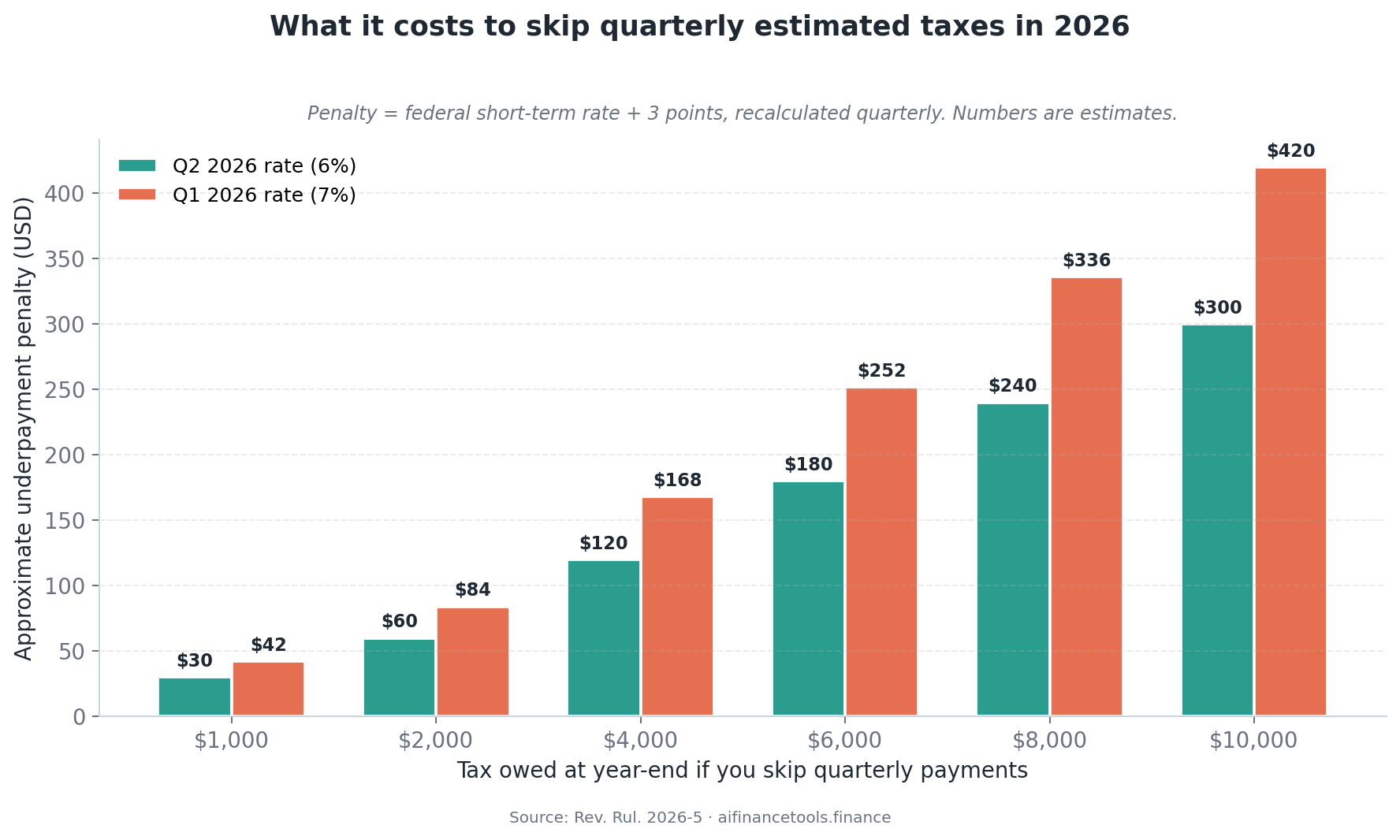
The other place freelancers sometimes “save” by misreading the rules is by not paying quarterly estimated taxes on income they think is invisible. That is a mistake. The IRS sets the underpayment penalty at the federal short-term rate plus 3 percentage points, recalculated quarterly. The rate was 7% annualized for Q1 2026 and dropped to 6% for Q2 2026 (per Rev. Rul. 2026-5). If you owe $4,000 and don’t pay quarterly, expect roughly $150 to $250 in penalties on a tax return filed in April. Our guide to quarterly estimated taxes covers the math.
 guide to quarterly estimated taxes covers the math.
,000 to
guide to quarterly estimated taxes covers the math.
,000 toThe other place freelancers sometimes “save” by misreading the rules is by not paying quarterly estimated taxes on income they think is invisible. That is a mistake. The IRS sets the underpayment penalty at the federal short-term rate plus 3 percentage points, recalculated quarterly. The rate was 7% annualized for Q1 2026 and dropped to 6% for Q2 2026 (per Rev. Rul. 2026-5). If you owe $4,000 and don’t pay quarterly, expect roughly $150 to $250 in penalties on a tax return filed in April. Our guide to quarterly estimated taxes covers the math.
0,000″ class=”wp-image-1610″/>The other place freelancers sometimes “save” by misreading the rules is by not paying quarterly estimated taxes on income they think is invisible. That is a mistake. The IRS sets the underpayment penalty at the federal short-term rate plus 3 percentage points, recalculated quarterly. The rate was 7% annualized for Q1 2026 and dropped to 6% for Q2 2026 (per Rev. Rul. 2026-5). If you owe $4,000 and don’t pay quarterly, expect roughly $150 to $250 in penalties on a tax return filed in April. Our guide to quarterly estimated taxes covers the math.
68.A 5-minute decision framework before you file
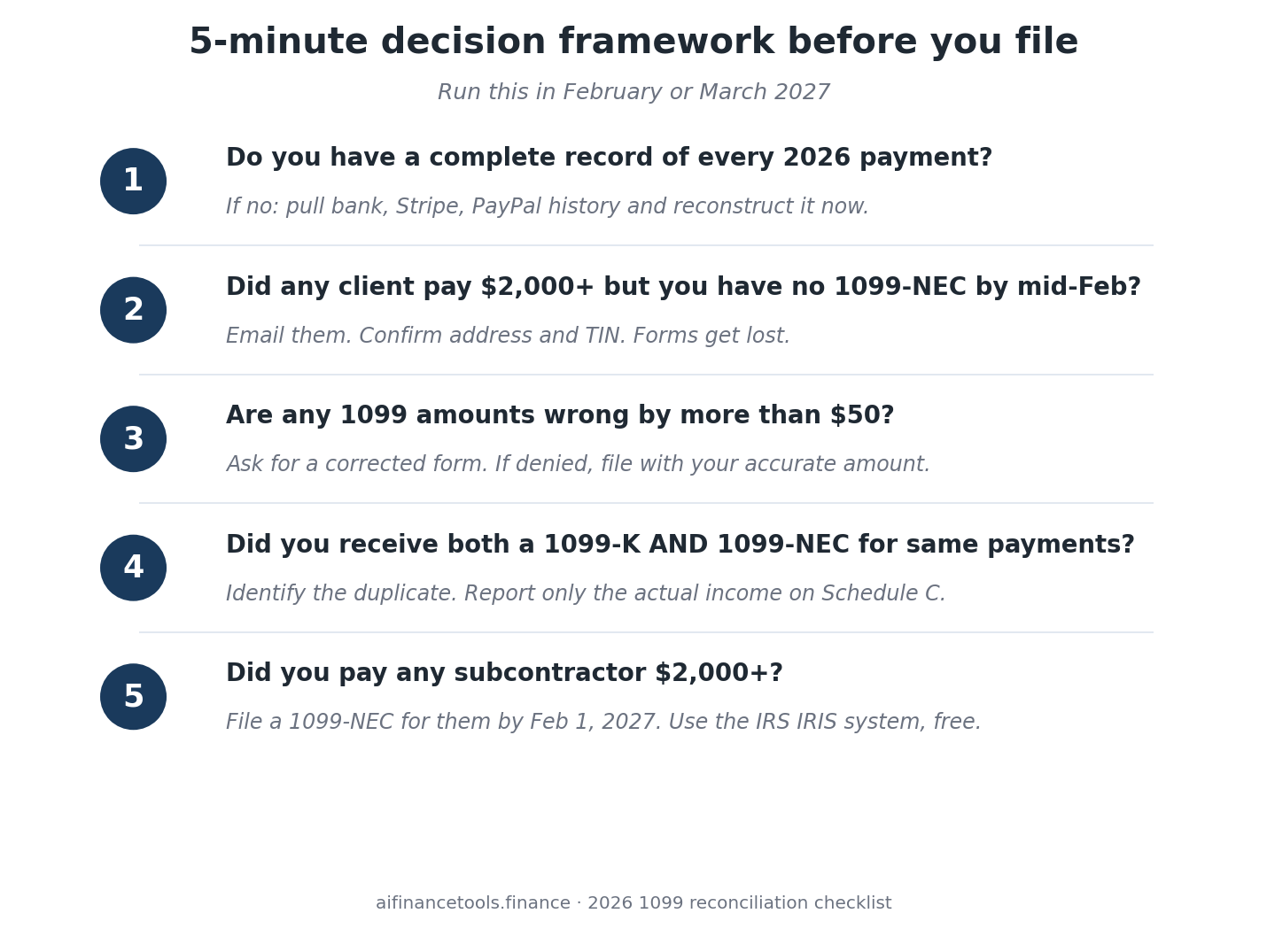
Run through these questions in order. Do this in February or March 2027 before you start your taxes for 2026.
- Do you have a complete record of every payment received in 2026? If yes, move on. If no, pull your bank statements, Stripe dashboard, PayPal history, and any other payment channels and reconstruct it now.
- Did any client pay you $2,000 or more in 2026 but you have not received a 1099-NEC by mid-February 2027? Email them. Confirm they have your correct address and TIN. Forms get lost. Forms get sent to wrong addresses. Forms sometimes don’t get filed. Either way, you still report the income.
- Are any of your 1099 amounts wrong? If a 1099 is more than $50 off from your records, contact the issuer and ask for a corrected form. If they refuse or take too long, you can still file using your accurate amount and attach a statement explaining the discrepancy.
- Did you receive a 1099-K AND a 1099-NEC from the same client or for the same payments? Identify the duplicate. Report only the actual income on Schedule C. Keep documentation in case the IRS asks.
- Did you pay any subcontractor $2,000 or more? File a 1099-NEC for them by February 1, 2027. The IRS uses the IRIS system for filing online. Free. Direct.
Free: 1099 reconciliation checklist for the 2026 tax year

A one-page checklist covering every payment channel where freelancers receive income, with the exact 1099 form (or absence) you should expect from each. Includes a worksheet for cross-referencing 1099-NEC against 1099-K to catch double-reporting. Built for the 2026 thresholds. Drop in your email and I will send it to you.
Tools that handle 1099 tracking automatically
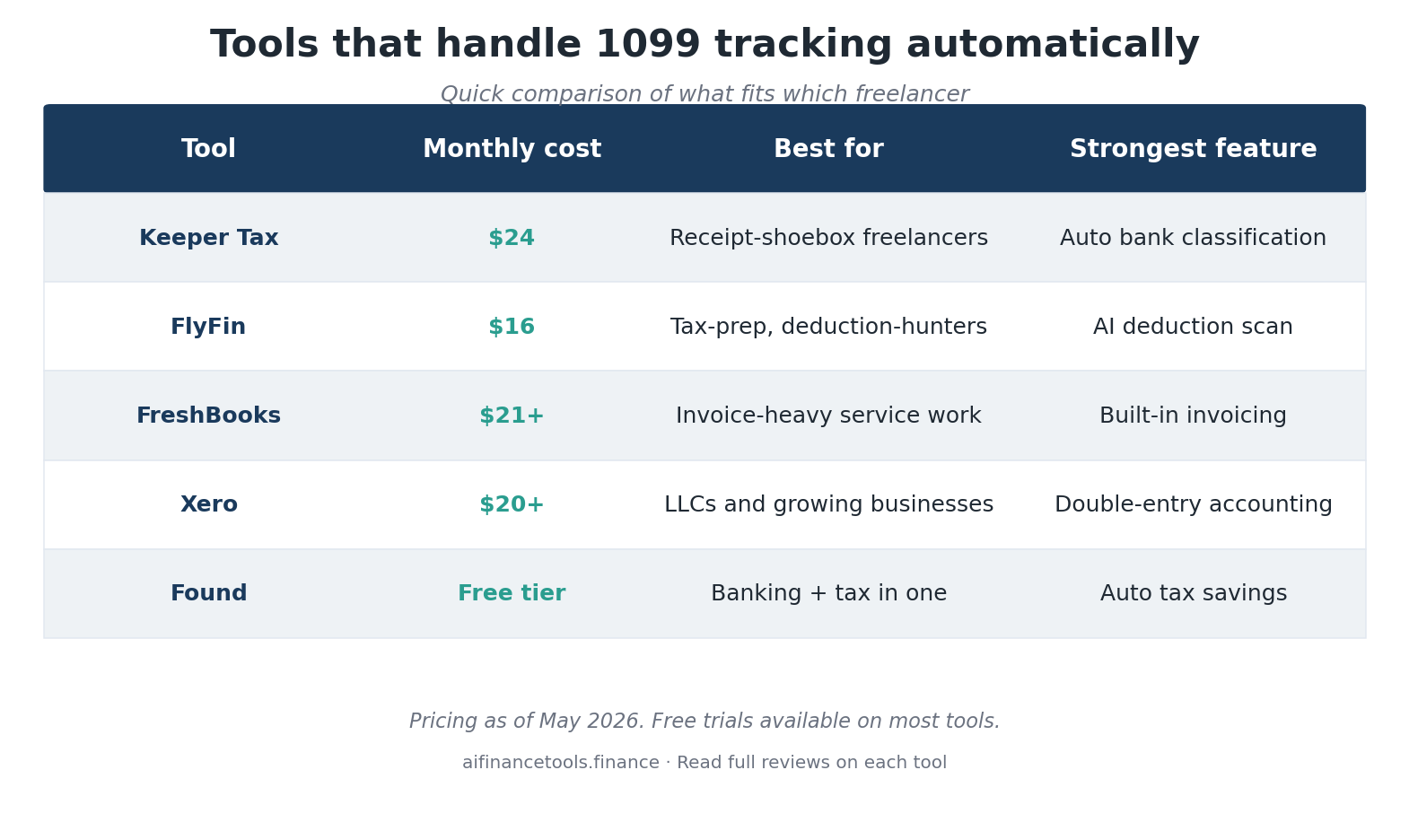
The threshold change makes self-tracking more important, not less. Three categories of tool worth looking at depending on how complex your finances are.
Expense and income trackers (under $30/month)
Keeper Tax connects to your bank and credit cards, classifies expenses, and tracks income. They handle 1099 imports for the 2026 tax year. Around $24 a month. Useful if your bookkeeping is currently a shoebox of receipts. Read our Keeper Tax review for the limits.
FlyFin uses an AI scan to surface deductions but is more focused on tax prep than ongoing bookkeeping. Around $192 a year for the basic plan. Strong on the “find me deductions I missed” angle, weaker on day-to-day income tracking. Our FlyFin review covers the gaps.
Start Your Free Trial with Keeper Tax
Full accounting software ($15 to $40/month)
FreshBooks and Xero both handle income tracking, invoicing, and expense categorization with proper double-entry accounting. FreshBooks starts at $21 a month for the Lite plan. Xero starts at $20 a month for Early. If you have an LLC or are billing more than $80,000 a year, this tier is worth the upgrade. The detailed comparison sits in our FreshBooks vs Xero breakdown.
Start Your Free Trial with FreshBooks
Business banking with built-in tax tracking
Found is a banking platform built for freelancers. It automatically categorizes income, sets aside tax savings, and generates a Schedule C-ready report at year-end. Free tier available. The auto-tax-savings feature alone is worth the switch if you have struggled with quarterly estimates. Compared with three alternatives in our freelancer bank account guide.
Open a Found Account
Frequently Asked Questions
Do I still get a 1099 in 2026?
You will get a 1099-NEC from any client who paid you $2,000 or more during the year for services. You will get a 1099-K from a payment platform like PayPal or Venmo only if you exceeded both $20,000 in payments and 200 transactions. If you take payments through Stripe, Square, or another card processor, you will get a 1099-K for any amount, even one transaction. Many freelancers will receive fewer total 1099s in early 2027 than they did in previous years. You still owe tax on every dollar of income whether you receive a form or not.
What is the $2,000 1099 threshold and when does it apply?
The $2,000 threshold is the new minimum amount a client must pay you in a calendar year before they are required to issue you a 1099-NEC or 1099-MISC. It applies to payments made after December 31, 2025. The 2025 tax year (filed in early 2026) still uses the old $600 threshold. Starting in 2027, the $2,000 figure will be adjusted for inflation each year. The threshold is per client, per calendar year. If two clients each pay you $1,500, neither has to issue a 1099, but you still owe tax on the full $3,000.
What OBBBA 1099 changes affect freelancers most?
Two changes hit freelancers directly. First, the 1099-NEC and 1099-MISC threshold went from $600 to $2,000 starting with payments made in 2026. Second, the 1099-K threshold reverted to over $20,000 plus over 200 transactions for third-party payment platforms, retroactive to 2022. The OBBBA also added new boxes to 1099-NEC and 1099-MISC for cash tips and overtime tied to the new “no tax on tips” deduction, which mostly affects tipped service occupations rather than knowledge-work freelancers. Backup withholding rules also align to the $2,000 threshold and remain at the 24% rate for contractors who fail to provide a valid W-9.
If a client paid me $1,800 in 2026, do I still report it?
Yes. The $2,000 threshold determines whether the client is required to file a 1099-NEC. It does not determine whether the income is taxable. All income from your business is taxable and must be reported on Schedule C, regardless of whether you received a 1099. If you skip reporting payments under $2,000, you are under-reporting income. The IRS can identify this through bank deposits, audit, or third-party data matching. Penalties for under-reporting include the original tax owed plus interest plus a possible accuracy-related penalty of 20% of the underpayment.
Does the new 1099-K rule apply to my Stripe payments?
No. The over $20,000 plus over 200 transaction threshold only applies to third-party settlement organizations like PayPal, Venmo, Cash App, eBay, and Etsy. Stripe and Square, when processing credit card or debit card transactions, are merchant card processors and have no minimum threshold. Stripe will issue a 1099-K for any payment volume processed through your account. If you primarily collect payments through Stripe, expect to receive a 1099-K every year regardless of how little you earned.
When will my 2026 1099s arrive?
Recipient copies of 1099-NEC must be furnished by January 31, 2027 (the deadline shifts to February 1, 2027 because January 31 falls on a Sunday). Recipient copies of 1099-K must also be furnished by January 31. Most arrive in the last week of January or first few days of February, either by mail or through email links from payment platforms. If you have not received an expected 1099 by mid-February, contact the issuer directly. Do not wait for it to file. You can use your own records of gross income to file accurately and let the missing form sort itself out later.
Are state 1099 thresholds the same as federal?
Not always. Several states maintain their own 1099 reporting thresholds that can be lower than the new federal $2,000 level. States like Massachusetts, Vermont, and Virginia have historically required 1099-K reporting at lower thresholds than the federal rule. After the OBBBA, some states are reviewing whether to match the federal rules or keep stricter reporting requirements. Check your state’s department of revenue for the current 2026 threshold. If you have clients or customers in multiple states, you may receive 1099s based on state thresholds even when the federal threshold has not been met.
Should I still send W-9s to clients in 2026?
Yes. Send a W-9 to any new client at the start of work, regardless of how much you expect to be paid. Clients do not always know how much they will pay you over the course of a year. A small project can grow. Several small projects with the same client can cumulatively exceed $2,000. Clients who lack a W-9 on file by year-end may withhold 24% of your payments for backup withholding, which means you wait until you file your tax return to recover that money. Sending the W-9 upfront is a 30-second task that prevents that headache.
This article is informational only and is not tax or legal advice. Tax laws change frequently. Verify current rules at IRS.gov, Publication 1099 (2026), and the IRS news releases on the One Big Beautiful Bill Act before making decisions. For specific tax questions about your situation, work with a CPA or enrolled agent who knows your full financial picture.
About the author
Gareth is an entrepreneur based in Dubai and the founder of AI Finance Tools for Freelancers. He’s not a CPA or a bookkeeper. He built this site because he couldn’t find honest, thorough reviews of AI finance tools written for freelancers. Every guide is researched from real user reviews, official documentation, and expert sources.